 MARLPIT PRESSIndependent Publisher
Early life and Wellesley
Eloise Lownsbery was born in Paw Paw, Illinois, on April 16, 1888. Standard biographical references identify her parents as Alexander W. and Martha Fisher Lownsbery. She graduated from Wellesley College with a B.A. in 1911.
The sixteen years between Wellesley and the appearance of her first book remain poorly documented in accessible sources. No reliable open record has yet established exactly where she worked throughout the 1910s, whether she taught before becoming an author, or precisely when she began writing professionally.
The Boy Knight of Reims and early success
The Boy Knight of Reims was published by Houghton Mifflin in 1927 with illustrations by Elizabeth Tyler Wolcott. The first edition ran to 332 numbered pages. It was Lownsbery’s first book.
Her second major historical novel, Out of the Flame, appeared in 1931 and was named a 1932 Newbery Honor Book. She went on to write historical and educational books including Lighting the Torch, Saints and Rebels, A Camel for a Throne, Gift of the Forest, Marta the Doll, and Alfred the Great.
Nicholas Roerich and 'Art applied to Ethics'
Lownsbery’s connection to Nicholas Roerich supplies the strongest surviving evidence for the intellectual background of her first novel. The book’s epigraph comes from Roerich, and the passage around that sentence moves directly from children and the power of art to the declaration that a new era requires “new knights.”
By 1929 Lownsbery was documented as an active fellow in the Roerich circle in New York. Around 1930 an official publication of Roerich’s Master Institute of United Arts listed her as the teacher of a “Class for Children in Art applied to Ethics.” That phrase provides a remarkably concise description of what The Boy Knight of Reims does in narrative form.
Children’s literature as a profession
By the 1940s Lownsbery was conducting sustained research at the Library of Congress. She, Catherine Cate Coblentz, and Alberta Powell Graham worked at adjacent desks; their conversations eventually developed into the Children’s Book Guild of Washington, formally organized in 1945.
Her publishing relationship was substantial as well. Harvard’s Houghton Library preserves 56 letters from Lownsbery and 80 letters to her in the Houghton Mifflin records, spanning 1926 through 1930. That correspondence begins before The Boy Knight of Reims appeared and is the most promising surviving archive for reconstructing the book’s exact editorial history.
Religion and responsible biography
Lownsbery’s first novel is deeply Catholic in setting, imagery, and moral imagination, but the available evidence does not establish that she herself was a Roman Catholic when she wrote it. Modern biography should keep those two questions separate.
Her documented spiritual associations were broad. After her involvement with the Roerich movement, she later held significant leadership positions in the Washington Friends of Buddhism during the 1950s and 1960s. Marlpit Press therefore describes the Catholic character of the novel directly rather than assigning Lownsbery a denominational identity the evidence does not support.
Marlpit Press edition
All books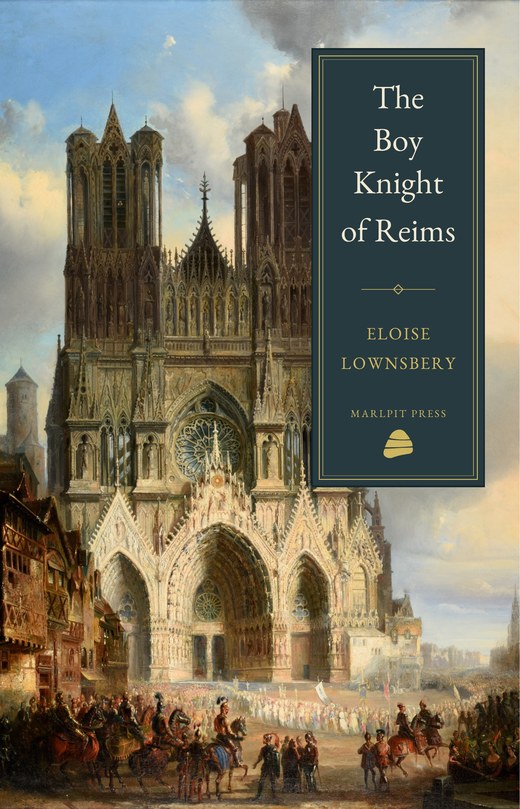
Research notes
All notesWhy Catholic Homeschoolers Read The Boy Knight of Reims
Why a 1927 novel about Reims Cathedral, artistic apprenticeship, Joan of Arc, and vocation remains assigned in Catholic curricula.
Read research noteWho Was Jean d’Orbais?
The real thirteenth-century architect of Reims Cathedral, Lownsbery’s fictional fifteenth-century descendant, and why the distinction matters.
Read research noteEloise Lownsbery, Nicholas Roerich, and the 'New Knights'
The Roerich epigraph, Lownsbery’s later teaching of 'Art applied to Ethics,' and the strongest evidence for what the novel was trying to do.
Read research note