A Catholic homeschool classic
The Boy Knight of Reims has a documented place in Catholic education. Our Lady of Victory School assigns it in its Grade 6 reading curriculum. Mother of Divine Grace School lists it among its Supplemental Required books, and MODG’s reading guide recommends it for established readers ages twelve and up.
That curriculum use makes sense. The novel gives young readers medieval history from inside a recognizably Catholic world. Mass, sacraments, saints, the Blessed Virgin, feast days, sacred architecture, vocation, and Joan of Arc are woven into ordinary life. They are part of the characters’ understanding of reality rather than historical decoration.
For parents building a Catholic or classical reading program, the book also has an unusual strength: its adventure grows out of formation. Jean learns patience, craft, courage, self-command, reverence, and the obligation to place his gifts at the service of something greater than himself.
What The Boy Knight of Reims is actually about
France, 1424. Ten-year-old Jean d’Orbais has grown up beneath the towers of Reims Cathedral, hearing stories of the craftsmen who built it and dreaming that he might one day do something worthy of their name. Apprenticed to a goldsmith, he discovers a gift for modeling and sculpture, but talent is only the beginning. His elders teach him that artistic ability creates duties.
Military knighthood supplies the title’s metaphor, but Jean’s true apprenticeship is artistic and spiritual. His family’s identity is bound to the cathedral, and his developing vocation leads toward an oath of service to Beauty and to Notre-Dame de Reims. The climactic symbolic knighting is performed with a craftsman’s chisel rather than a warrior’s sword.
That gives the novel a very different moral center from the usual medieval adventure story. Jean becomes worthy of knighthood by learning how to make beautiful things well, and by understanding that a gift becomes noble when it is used in service.
Joan of Arc, Reims, and the Hundred Years’ War
The political story develops gradually around Jean’s private education. The opening chapter is dated July 26, 1424. As the years pass, war divides France, Charles VII remains uncrowned, and reports begin to spread about a young woman who says God has sent her to save the kingdom.
By 1429 the two stories converge. Joan of Arc and Charles VII move toward Reims for the coronation, while Jean’s own artistic vocation reaches maturity. Lownsbery uses the cathedral to join sacred history, national history, family memory, and craftsmanship in a single place.
This chronology also corrects a persistent error found in old publisher-derived descriptions online: the novel is set in the fifteenth century, principally 1424–1429, not the fourteenth century.
Beauty, vocation, and the idea of a 'new knight'
The deepest theme of the book is the formation of character through beauty and disciplined work. Lownsbery’s epigraph comes from Nicholas Roerich, the artist and cultural thinker whose writings treated art and beauty as moral forces in education. In the passage surrounding the sentence Lownsbery selected, Roerich speaks about children, art, culture, and the need for “new knights.”
That connection is especially striking because Lownsbery later became part of Roerich’s New York circle and taught children at his Master Institute of United Arts in a class described as “Art applied to Ethics.” The novel reads almost like that phrase turned into a story: Jean’s artistic gift must be trained until technique, moral discipline, and service become one vocation.
For Catholic readers, the cathedral gives that idea a specifically sacred form. Jean’s work belongs to generations of builders, craftsmen, worshippers, and saints. He learns that beauty is something received, guarded, and handed on.
Catholicism in the novel
The book’s imagined world is unmistakably Catholic. Jean’s identity is inseparable from Notre-Dame de Reims. Sacraments, prayer, saints, Marian devotion, liturgy, feast days, relics, sacred architecture, and Joan of Arc organize the characters’ lives and moral imagination.
Jean’s vocation ultimately becomes Marian service when he is made a knight of the Blessed Virgin in the cathedral’s service. Lownsbery’s dedication to “all children, all saints, all angels” reinforces the same sacred framework.
Marlpit Press does not describe Lownsbery herself as a Catholic author, because the available evidence does not establish her personal denomination in 1927. The novel’s Catholic character, however, is abundantly present in the text itself.
About Eloise Lownsbery
Eloise Lownsbery (1888–1967) was born in Paw Paw, Illinois, and graduated from Wellesley College in 1911. The Boy Knight of Reims, published by Houghton Mifflin in 1927 and illustrated by Elizabeth Tyler Wolcott, was her first book.
Her next major historical novel, Out of the Flame, became a 1932 Newbery Honor Book. She continued writing historical and educational books for young readers, later conducted sustained research at the Library of Congress, and helped form the Children’s Book Guild of Washington.
Her surviving career records are unusually revealing about the seriousness with which she treated children’s literature. In addition to her Roerich-era teaching work, Houghton Library at Harvard preserves 136 pieces of correspondence between Lownsbery and Houghton Mifflin from 1926 through 1930, beginning before publication of her first novel.
About this Marlpit Press edition
This edition returns Lownsbery’s 1927 novel to print for the readers who have kept it alive: families, schools, homeschoolers, and young readers drawn to historical fiction with a serious moral and religious imagination.
The presentation preserves the novel as a readable work of fiction rather than turning it into a textbook. The book’s strongest educational material is already inside the story: the daily work of a medieval craftsman, the life of a cathedral city, the movement toward Joan of Arc’s arrival at Reims, and Jean’s gradual understanding of vocation.
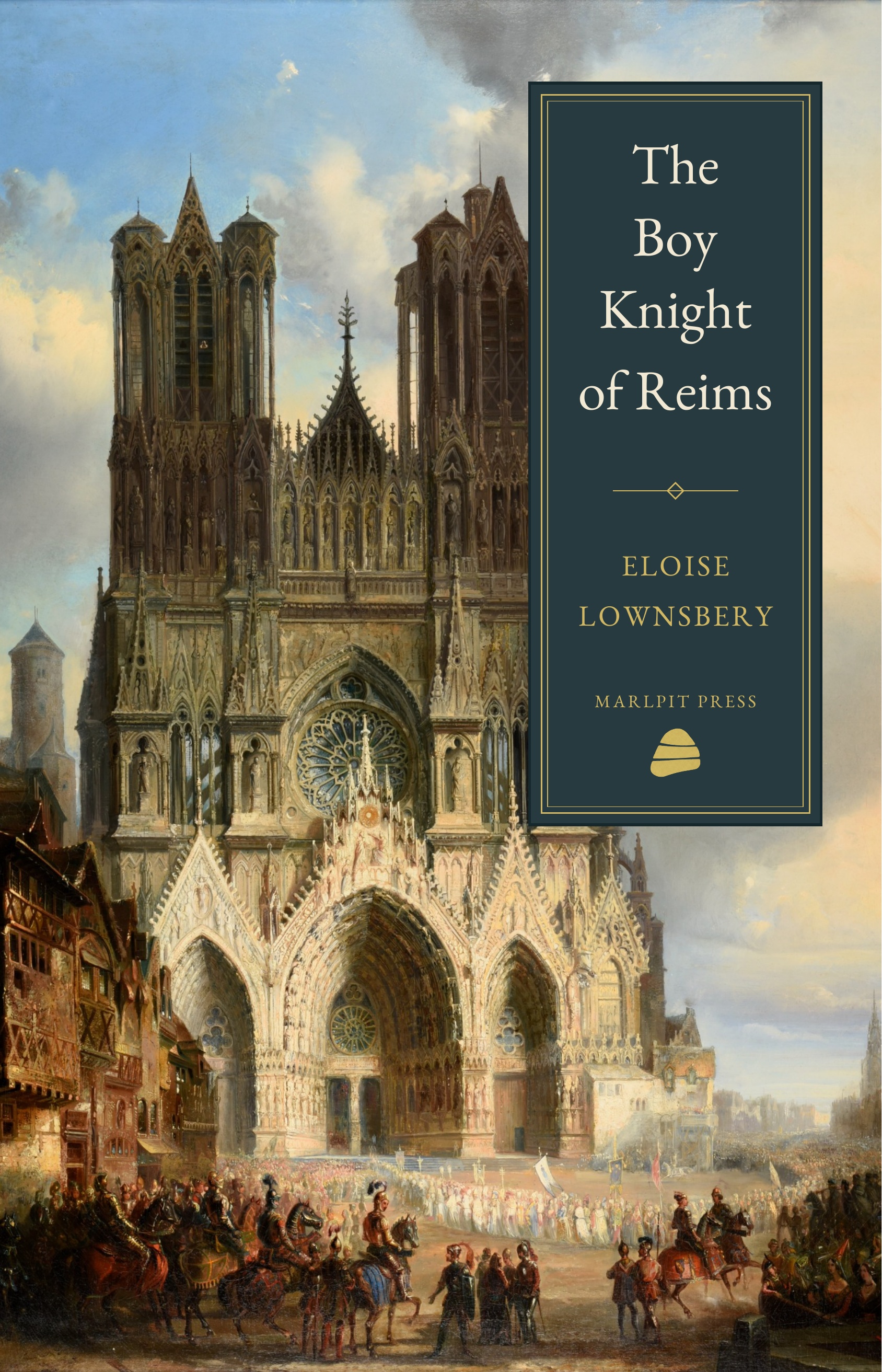
The cover features Reims Cathedral and visually centers the same object that dominates Jean’s imagination throughout the novel.
 MARLPIT PRESSIndependent Publisher