Why this book matters
When Otto Rank published Der Mythus von der Geburt des Helden in 1909, he took a problem that had occupied generations of comparative mythologists and gave it a new psychological explanation. Again and again, he observed, cultures tell of an exceptional child born to distinguished parents, threatened before he can grow, exposed or hidden, rescued and raised elsewhere, then restored to his true identity. Sargon, Moses, Oedipus, Perseus, Romulus, Siegfried, and other heroes become variations on a recognizable narrative pattern.
Rank’s historical innovation was not simply identifying that pattern. Earlier folklorists had already compared recurring heroic biographies. Rank interpreted the pattern through the new language of psychoanalysis, connecting heroic legend to childhood relations with parents, the “family romance,” rivalry, separation, fantasy, and the wish to remake one’s origins. Freud himself later said that Rank wrote the book at his suggestion and while still under his influence. Rank presented the work to the Vienna Psychoanalytic Society in November 1908, before the book appeared the following year.
The result is historically important even where Rank’s Freudian explanation no longer commands scientific assent. His catalogue of recurring motifs became part of the modern history of hero-pattern studies, while the book records the moment psychoanalysis moved aggressively beyond medicine into mythology, literature, religion, and culture.
The 1909 and 1922 editions
The publication history is essential to understanding the book. The first German edition appeared in 1909 and was translated into English in 1914. That early English version made Rank’s youthful, strongly Freudian argument familiar to generations of readers.
Rank returned to the work in 1922 and substantially enlarged it. The second German edition incorporated thirteen additional years of psychoanalytic, mythological, folkloric, and ethnological reading. It was not a light revision. The book grew dramatically, adding evidence, discussion, and qualifications that change the scale and texture of the work. Theodor Reik, reviewing the new edition in 1922, welcomed the enlarged body of evidence while also wondering whether the accumulation of material had weakened the compact unity of the original.
For English readers, that distinction has often been blurred because the 1914 translation represents the shorter 1909 text. The complete expanded version did not receive a full published English translation until Gregory C. Richter and E. James Lieberman’s Johns Hopkins University Press edition in 2004.
About this Marlpit Press edition
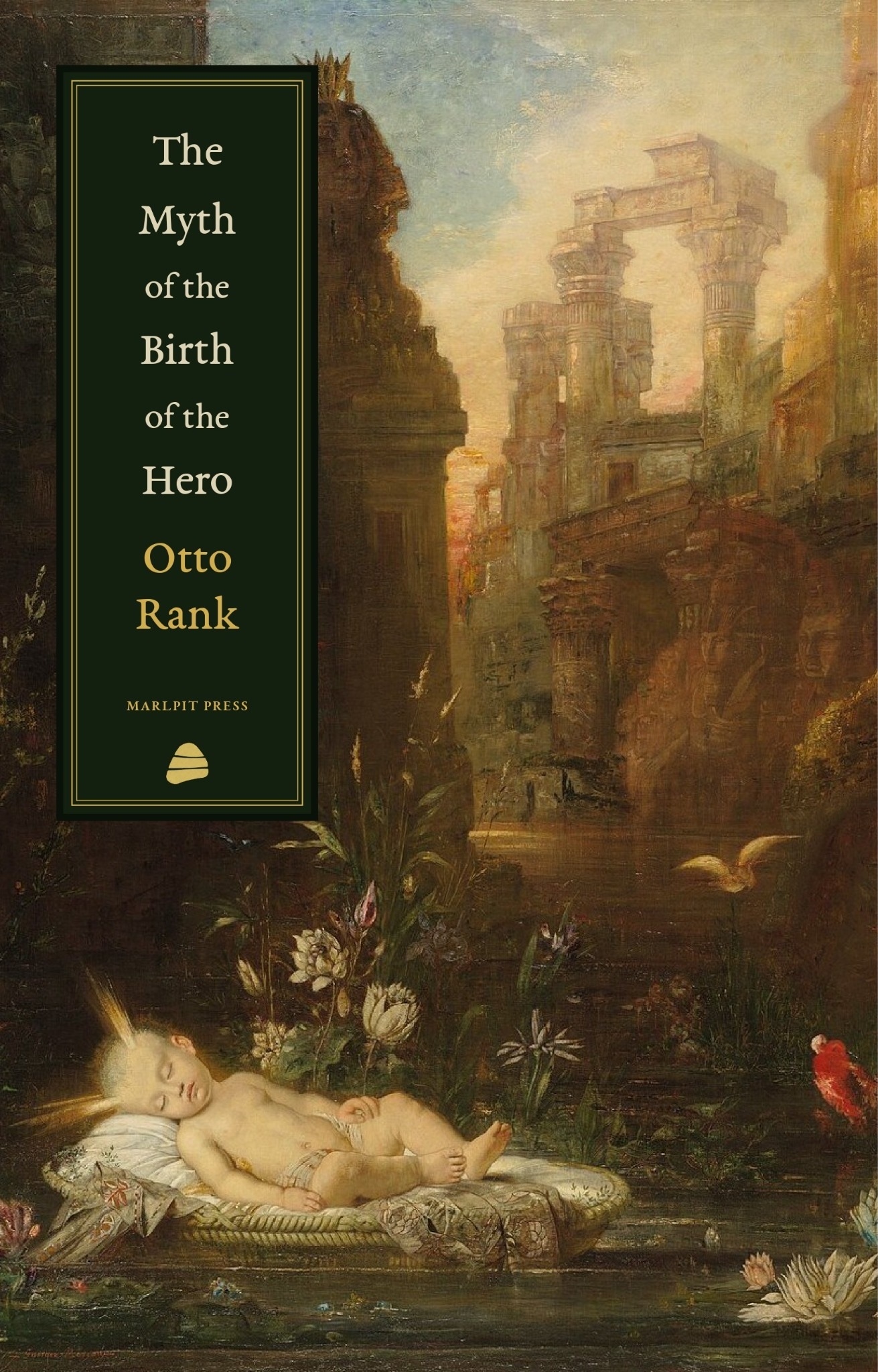
This Marlpit Press edition presents a new English translation of Rank’s revised and substantially expanded 1922 German text. The aim is to give readers the fuller book Rank ultimately made, while preserving the historical character of its argument and terminology rather than silently turning it into a modern theory it was never meant to be.
The volume also includes Alfred Nutt’s 1881 essay The Aryan Expulsion-and-Return-Formula in the Folk and Hero Tales of the Celts. Nutt was working almost three decades before Rank and explicitly developed Johann Georg von Hahn’s earlier hero formula against Celtic material including Fionn, Cuchulainn, Perceval, Arthur, Merlin, and Taliesin. His method is comparative rather than psychoanalytic: he tabulates recurring incidents, tests a formula against evidence, and allows the pattern to change when the stories resist it.
There is no good evidence that Rank directly borrowed his pattern from Nutt. That is precisely why the pairing is useful. Read together, the two texts show successive phases in the history of the same problem: first the comparative morphology of heroic narrative, then Rank’s attempt to explain that morphology through unconscious psychology.
About Otto Rank
Otto Rank was born Otto Rosenfeld in Vienna in 1884. Trained first as a locksmith and largely self-educated in literature, philosophy, music, and art, he entered Freud’s circle without the medical or academic credentials of many early psychoanalysts. Freud recognized his unusual ability and brought him into the small Vienna group that became the Psychoanalytic Society.
Rank became the society’s secretary, an editor and institution builder, and one of Freud’s closest early collaborators. He earned a doctorate in philosophy from the University of Vienna in 1912 and wrote prolifically on myth, art, literature, creativity, incest, and psychology. Later he broke with Freud and developed increasingly independent ideas about will, separation, creativity, and psychotherapy. The Myth of the Birth of the Hero, written when he was only twenty-five, remains one of the clearest documents of his early place at the intersection of psychoanalysis and the humanities.
The Myth of the Birth of the Hero
Marlpit Press edition · ISBN 979-8193985761
 MARLPIT PRESSIndependent Publisher