 MARLPIT PRESSIndependent Publisher
The 1909 and 1922 Editions of Otto Rank’s Hero Myth
The familiar early English translation of Otto Rank’s The Myth of the Birth of the Hero does not represent the final form of the book. Rank returned to it thirteen years after its first German publication and substantially enlarged the work.
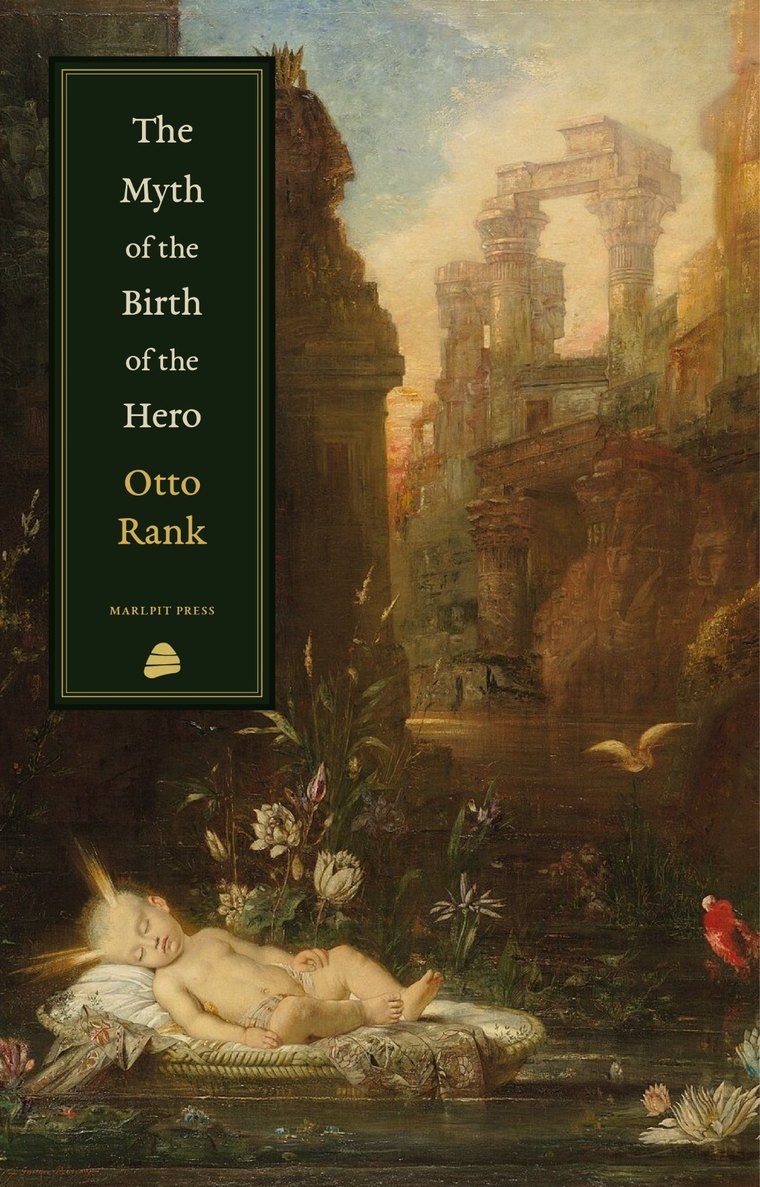
The compact book of 1909
Rank’s first edition appeared in German in 1909, when he was twenty-five and deeply embedded in Freud’s circle. He had already presented the argument to the Vienna Psychoanalytic Society in November 1908. Freud later said that Rank wrote the book at his suggestion and while still under his influence, and the intellectual collaboration around Freud’s “family romance” supplied part of the psychological framework.
The 1909 book takes a comparative-mythological problem and gives it a psychoanalytic solution. Rank assembles birth legends in which a heroic child is born to distinguished parents, threatened by prophecy or paternal hostility, exposed or abandoned, rescued and raised elsewhere, then reunited with his true origins and restored to greatness. Earlier scholars had noticed overlapping patterns. Rank’s distinctive move was to interpret them through fantasies of childhood, parental rivalry, separation, and the wish to replace ordinary parents with idealized ones.
The first English translation
An English translation followed in 1914. That translation was historically important because it made Rank’s argument available to a much wider Anglophone readership and helped establish the book as a classic of early psychoanalytic mythology.
It also created a long bibliographic trap. Readers encountering that English text could reasonably assume they were reading “the” Rank book. In fact they were reading the shorter first version. When Rank substantially rebuilt the German work in 1922, the familiar English translation did not grow with it.
What Rank did in 1922
The second German edition was not a cosmetic correction. Rank had spent the intervening thirteen years at the center of the psychoanalytic movement, editing journals, working with Freud, publishing on myth, art, literature, and incest, and absorbing a much wider field of ethnological and folkloric evidence. He poured that accumulation back into the book.
The 1922 edition grew dramatically, adding myths, comparative material, citations, psychological discussion, and qualifications. Theodor Reik’s contemporary review captured the tradeoff: he welcomed the greatly enlarged evidence but thought the weight of new material had compromised some of the original book’s compact unity. That is useful evidence that contemporary readers themselves experienced the second edition as a materially different work.
The change also matters intellectually. The 1922 text shows what happened when an elegant youthful thesis encountered another decade of evidence. The core psychoanalytic explanation remains, but it is surrounded by a much larger comparative apparatus. Readers can see Rank both reinforcing his original argument and struggling with the abundance of material that exceeds any simple formula.
Why English readers often miss the distinction
For most of the twentieth century, the accessible English Rank was still the version derived from 1909. The complete expanded text did not receive a full English translation until Gregory C. Richter and E. James Lieberman’s Johns Hopkins University Press edition in 2004.
That publication history explains why references to the book can seem contradictory. A scholar may describe a short early psychoanalytic essay-like monograph, while another discusses a much larger comparative work. Both may be talking about The Myth of the Birth of the Hero, but not about the same textual state.
Why Marlpit uses the 1922 text
The Marlpit Press edition is based on the substantially expanded 1922 German work because that is Rank’s final major authorial form of the book. It is translated anew rather than treating the 1914 English text as a base that merely needs cleaning.
The edition also appends Alfred Nutt’s 1881 study of the expulsion-and-return formula. That pairing makes the historical development visible: Nutt and the earlier comparative tradition were asking how recurring heroic biographies could be described; Rank inherited the broad problem and transformed it into a question about unconscious psychology. The relationship is illuminating even though there is no evidence that Rank directly copied Nutt’s formula.
Research basis
This note draws on primary and scholarly material assembled for the Marlpit Press edition and research dossier.
- Otto Rank, 1909 and 1922 German editions
- Freud and Vienna Psychoanalytic Society records
- Theodor Reik’s 1922 review
- Gregory C. Richter and E. James Lieberman, Johns Hopkins complete translation (2004)
Continue reading
The Myth of the Birth of the Hero edition · Otto Rank biography · Alfred Nutt before Rank