 MARLPIT PRESSIndependent Publisher
From locksmith to psychoanalysis
Otto Rank was born Otto Rosenfeld in Vienna on 22 April 1884 into a financially constrained artisan family. While his older brother received more conventional educational support, Otto trained as a locksmith and worked in a machine shop. Literature, philosophy, music, and art became a parallel education. Ibsen, Nietzsche, Schopenhauer, and Wagner were among the writers who mattered to him.
That background helps explain the direction of his later work. Rank did not enter psychoanalysis through medicine. He entered through literature, dreams, mythology, and the problem of artistic creation. As a young man he adopted the name Rank and later made it legal, a biographical detail that sits suggestively beside his lifelong interest in separation, self-creation, and the remaking of identity.
Freud’s young collaborator
Rank came to Freud’s attention while still outside the academic establishment. Freud was impressed by a manuscript linking dream theory with art and brought him into the small Vienna group that became the Psychoanalytic Society. Rank became secretary of the organization in 1906, taking minutes, managing publications and administration, and absorbing psychoanalytic theory while it was still being formed.
Freud encouraged Rank’s education. Rank eventually earned a Ph.D. in philosophy from the University of Vienna in 1912 and became a non-medical psychoanalyst, editor, writer, and institution builder. He was part of Freud’s inner circle and helped carry psychoanalysis into the study of myth, literature, folklore, and art.
Myth, art, and independence
Rank’s early books included Der Künstler (1907), The Myth of the Birth of the Hero (1909), work on the Lohengrin legend, and a major study of the incest motif in literature and legend. The Myth of the Birth of the Hero, written when he was twenty-five, became one of the earliest sustained attempts to use psychoanalysis to explain a cross-cultural narrative pattern.
His relationship with Freud eventually fractured. Rank’s later thought placed increasing emphasis on will, creativity, separation, birth, individuality, and the therapeutic relationship. Those ideas helped make him one of the most significant early figures to emerge from Freud’s circle and then develop an independent psychology.
Marlpit Press edition
All books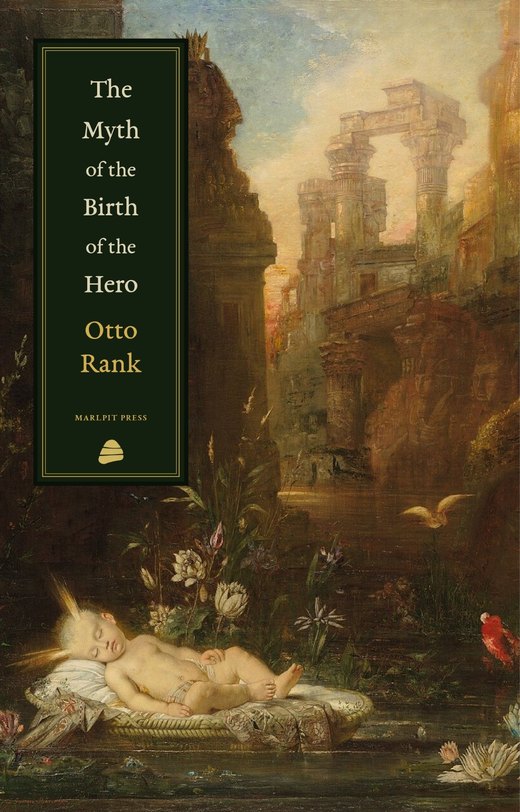
Research notes
All notesThe 1909 and 1922 editions
What changed between Otto Rank's 1909 and substantially expanded 1922 editions of The Myth of the Birth of the Hero, and why the difference matters.
Read research noteAlfred Nutt before Otto Rank
How Alfred Nutt's 1881 expulsion-and-return study and Johann Georg von Hahn's earlier formula anticipate the hero pattern later associated with Otto Rank.
Read research note