A Victorian argument disguised as a house party
The New Republic; or, Culture, Faith, and Philosophy in an English Country House gathers a group of cultivated guests and lets them talk. Beneath the drawing-room wit is one of the central anxieties of late Victorian intellectual life: if educated people cease to believe in God, immortality, revelation, and an objective supernatural order, what happens to morality, culture, social obligation, pleasure, and the idea of a life worth living?
Mallock builds the book as a philosophical dialogue, society novel, roman à clef, parody anthology, Oxford satire, and intellectual comedy. The guests are thinly disguised versions or composites of famous contemporaries. Benjamin Jowett, Matthew Arnold, Walter Pater, John Ruskin, Thomas Huxley, John Tyndall, W. K. Clifford, and others hover behind the fictional speakers.
The pleasure comes partly from recognition, but the caricatures are not the whole point. Mallock later described the book’s governing problem as the “rational aim of life.” He wanted to know what ends could remain authoritative once inherited religious certainty had been dissolved by modern criticism and science.
The young Mallock and his targets
Mallock was only twenty-eight when the book appeared in volume form in 1877. Parts had already appeared in Belgravia in 1876. He wrote from unusually intimate knowledge of the world he mocked. He had grown up in a Devonshire gentry family connected to the Froudes, studied at Balliol during Benjamin Jowett’s ascendancy, knew John Ruskin, and moved among many of the intellectual and social circles from which his characters were drawn.
Some portraits are affectionate, some playful, and some cruel. The treatment of Walter Pater became entangled with a much uglier Oxford controversy surrounding Pater’s private life and career. It is too simple to make Mallock alone responsible for what followed, but the episode shows how a witty roman à clef could carry consequences beyond literary comedy.
The book provoked strong reactions. Oscar Wilde later admired Mallock’s talent. Matthew Arnold recognized himself in the satire. George Eliot disliked the book intensely. Benjamin Disraeli reportedly admired it. The mixture of delight and irritation was built into its method: the joke works because the targets were living participants in arguments that mattered.
Why the book still reads strangely well
Many Victorian “novels of ideas” turn into historical documents once the debates that animated them fade. The New Republic remains livelier because Mallock dramatizes ideas as manners, vanity, flirtation, social rivalry, aesthetic performance, and conversational combat. Philosophies acquire voices and bodies.
The central problem also survived its original moment. Mallock’s answers are historically situated and often polemical, but the question of whether inherited moral values can survive after their metaphysical foundations are rejected remains recognizable. The book catches a culture trying to decide what should replace the certainties it had begun to lose.
About this Marlpit Press edition
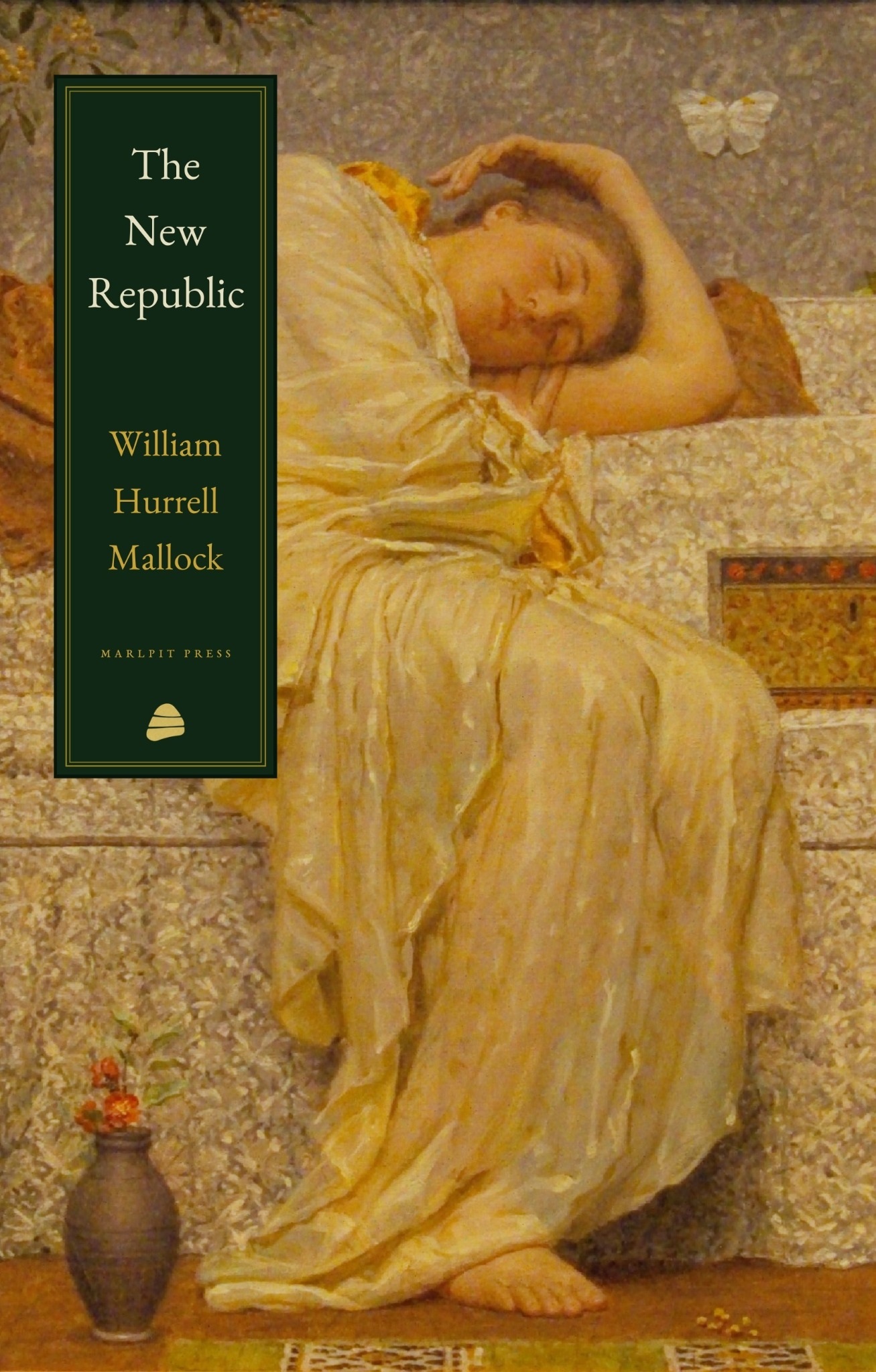
This Marlpit Press edition presents Mallock’s 1877 satire in a clean, newly typeset form designed to let the dialogue move at conversational speed. The book’s historical setting and recognizable models are part of the reading experience, so the edition gives readers enough context to understand who is being parodied and why the arguments mattered.
The aim is to recover The New Republic as more than a footnote to Pater, Arnold, Ruskin, or Jowett. It is a work with its own organizing question, comic method, and place in the history of Victorian religious and intellectual debate.
About William Hurrell Mallock
William Hurrell Mallock (1849–1923) was an English novelist, poet, critic, and social and religious controversialist. He came from the Devonshire gentry and was connected through his mother to the remarkable Froude family: the Tractarian Richard Hurrell Froude, historian James Anthony Froude, and engineer William Froude.
At Balliol College, Oxford, Mallock entered the intellectual world he would soon satirize and won the Newdigate Prize in 1871. He went on to write on religion, political economy, socialism, democracy, culture, and social hierarchy. The New Republic, written while he was still a young man, made him suddenly famous and remains the work through which his complicated place in Victorian intellectual history is most easily recovered.
The New Republic
Marlpit Press edition · ISBN 979-8193407447
 MARLPIT PRESSIndependent Publisher