Why this book matters
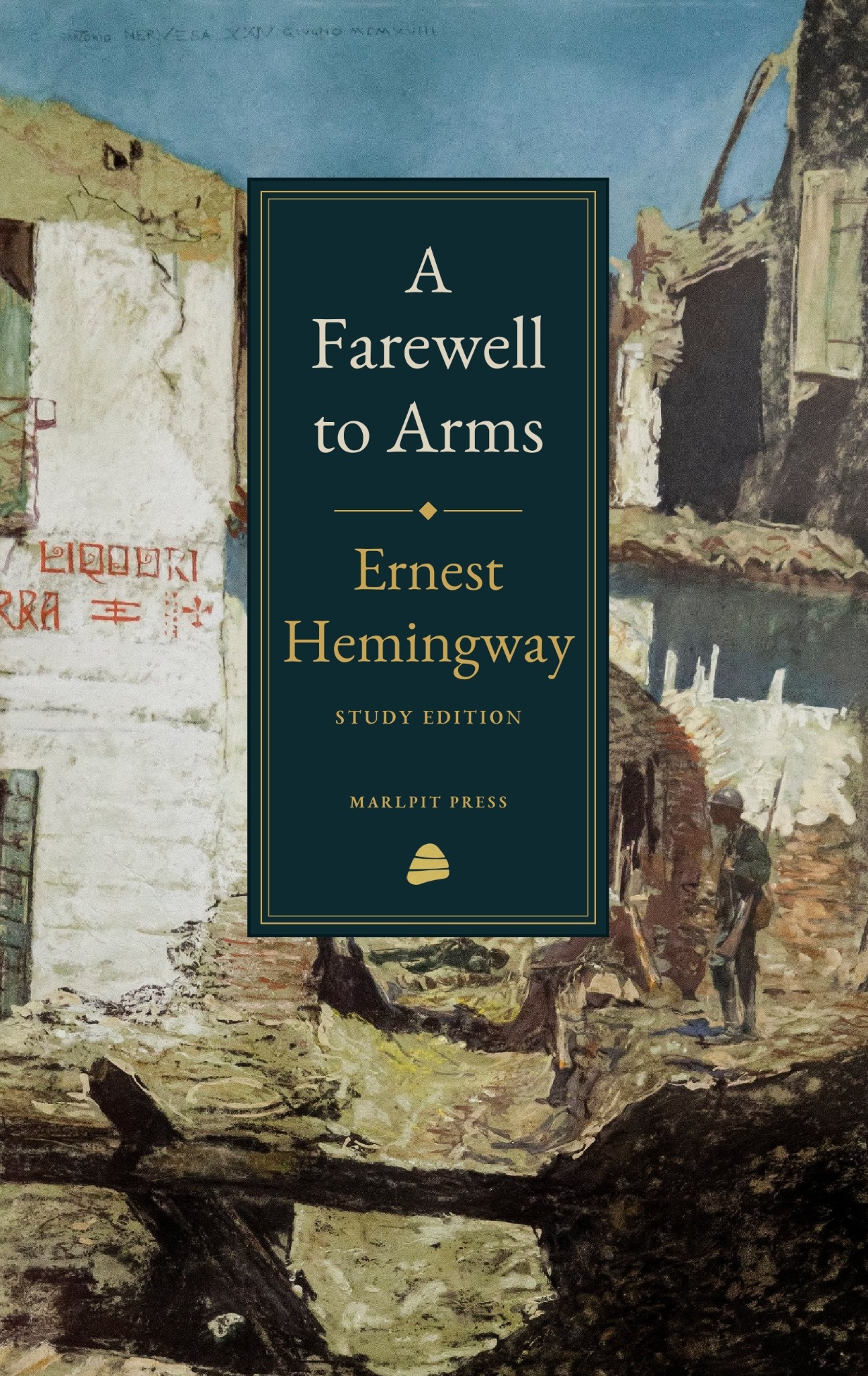
A Farewell to Arms appeared on September 27, 1929, when Ernest Hemingway was thirty. He was already one of the most visible younger American writers, but this novel changed the scale of his career. It became his first enormous commercial success while also receiving unusually strong reviews in the United States and Britain. The result fixed Hemingway’s reputation as both a major modernist and a writer with a mass audience.
The novel joins two kinds of catastrophe. Frederic Henry serves with an Italian ambulance unit while the war on the Italian Front moves toward the collapse at Caporetto. At the same time, his relationship with Catherine Barkley becomes an attempt to build a private life outside military abstractions. The movement from army to lovers, and finally from two people to one, gives the book its extraordinary narrowing structure.
Its apparent simplicity is intensely made. Repetition, cumulative syntax, ordinary physical detail, understatement, and dialogue carry emotions Hemingway often refuses to explain directly. The final pages became the most famous example of that revision ethic: Hemingway said he rewrote the ending thirty-nine times, while the surviving archive contains still more ending drafts and variants.
Life, memory, and invention
The novel draws powerfully on Hemingway’s First World War experience without reproducing it literally. In July 1918, at eighteen, he was badly wounded near Fossalta di Piave while serving with the American Red Cross. He recovered in Milan and fell in love with the American nurse Agnes von Kurowsky. Their surviving letters show a relationship more serious and reciprocal than the old story of an older nurse merely humoring an infatuated teenager.
Those experiences supplied emotional memory, hospital detail, Italian landscapes, and the shock of bodily injury. Hemingway nevertheless invented the structure that turns them into fiction. Frederic Henry’s military circumstances are not Hemingway’s. Catherine Barkley is British while Agnes was American. Catherine’s pregnancy and death are fictional. Pauline Hemingway’s difficult childbirth in 1928, while the novel was being written, supplied a much closer biographical parallel to Catherine’s final ordeal.
The central military event is the clearest warning against reading the novel as disguised memoir. Hemingway did not witness Caporetto. The retreat occurred in October 1917, months before he reached Italy. He reconstructed it through deliberate historical research, collecting maps, photographs, aerial views, and other material while combining that evidence with his firsthand knowledge of Italy and soldiers under pressure.
Writing, revision, and publication
Hemingway began sustained work on the novel in early 1928 after abandoning a much looser project he had described to Maxwell Perkins as a modern Tom Jones. He wrote across Paris, Key West, Piggott in Arkansas, Kansas City, and Wyoming, completing a first draft by late summer or early autumn. The speed of the first draft was followed by months of severe revision.
During that revision Hemingway’s father, Clarence Hemingway, died by suicide in December 1928. Hemingway’s letters show that the death temporarily made it difficult for him to return mentally to the manuscript. He nevertheless resumed work and had a semi-final draft by January 1929, continuing to revise the ending afterward.
Scribner’s serialized the novel from May through October 1929 and paid $16,000 for the serial rights. Magazine publication required cuts and euphemisms that Hemingway resisted more strongly when the trade edition was prepared. Boston authorities suppressed the June issue of Scribner’s Magazine, adding censorship controversy to the attention already surrounding the book. When the novel appeared in book form, it became a bestseller within roughly two weeks.
About this Complete Study Edition
The Complete Study Edition is designed around one basic problem: Hemingway expected his first readers to recognize a world that has become increasingly remote. In 1929, Caporetto, the Tagliamento, Gorizia, Italian military ranks, Carabinieri, wartime hospitals, and the geography of the northern Italian campaign required far less explanation than they do now.
Everything placed before the novel is designed to be used without plot spoilers. The introductory material includes a historical essay on Hemingway and the making of the novel, an account of the Italian Front, a chronology of the retreat from Caporetto, a Hemingway chronology, a character guide, and a guide to terms and places. The aim is to restore context before asking the reader to interpret the story.
The material following the novel is for closer study after the final chapter: historical and cultural notes, chapter-by-chapter summaries and analysis, discussion questions, treatment of major themes and motifs, fuller character analysis, and further reading. Historical explanation is separated from literary interpretation wherever possible, so facts about a military rank or medical practice do not get presented as if they settled questions about Catherine, rain, Frederic’s development, or the meaning of the ending.
About Ernest Hemingway
Ernest Miller Hemingway was born in Oak Park, Illinois, in 1899. After high school he worked briefly for the Kansas City Star, then joined the American Red Cross and went to Italy in 1918. His wartime wounding, Milan convalescence, and relationship with Agnes von Kurowsky became part of the imaginative material he transformed across his early fiction.
In the 1920s Hemingway became part of the expatriate literary world of Paris. In Our Time, The Sun Also Rises, and Men Without Women established his reputation before A Farewell to Arms made him an international literary figure. Later books included Death in the Afternoon, For Whom the Bell Tolls, and The Old Man and the Sea. He received the 1953 Pulitzer Prize for The Old Man and the Sea and the 1954 Nobel Prize in Literature.
The enormous manuscript archive now held by the John F. Kennedy Presidential Library makes Hemingway unusually visible as a reviser. For A Farewell to Arms, that archive preserves the drafts behind a novel whose prose often tries to make extraordinary effort look inevitable.
The Complete Study Edition
Historical context before the novel; annotations, analysis, discussion questions, and further reading after it.
Buy on Amazon MARLPIT PRESSIndependent Publisher