Biography as strategic argument
B. H. Liddell Hart did not choose William Tecumseh Sherman merely because Sherman offered a dramatic Civil War life. In 1928 Hart was invited to write a book on the war and chose Sherman over the more commercially obvious Robert E. Lee. The western campaigns gave him a historical case through which to think about the problem that had haunted him since the First World War: how an army might break an enemy’s resistance without repeating the frontal slaughter of the trenches.
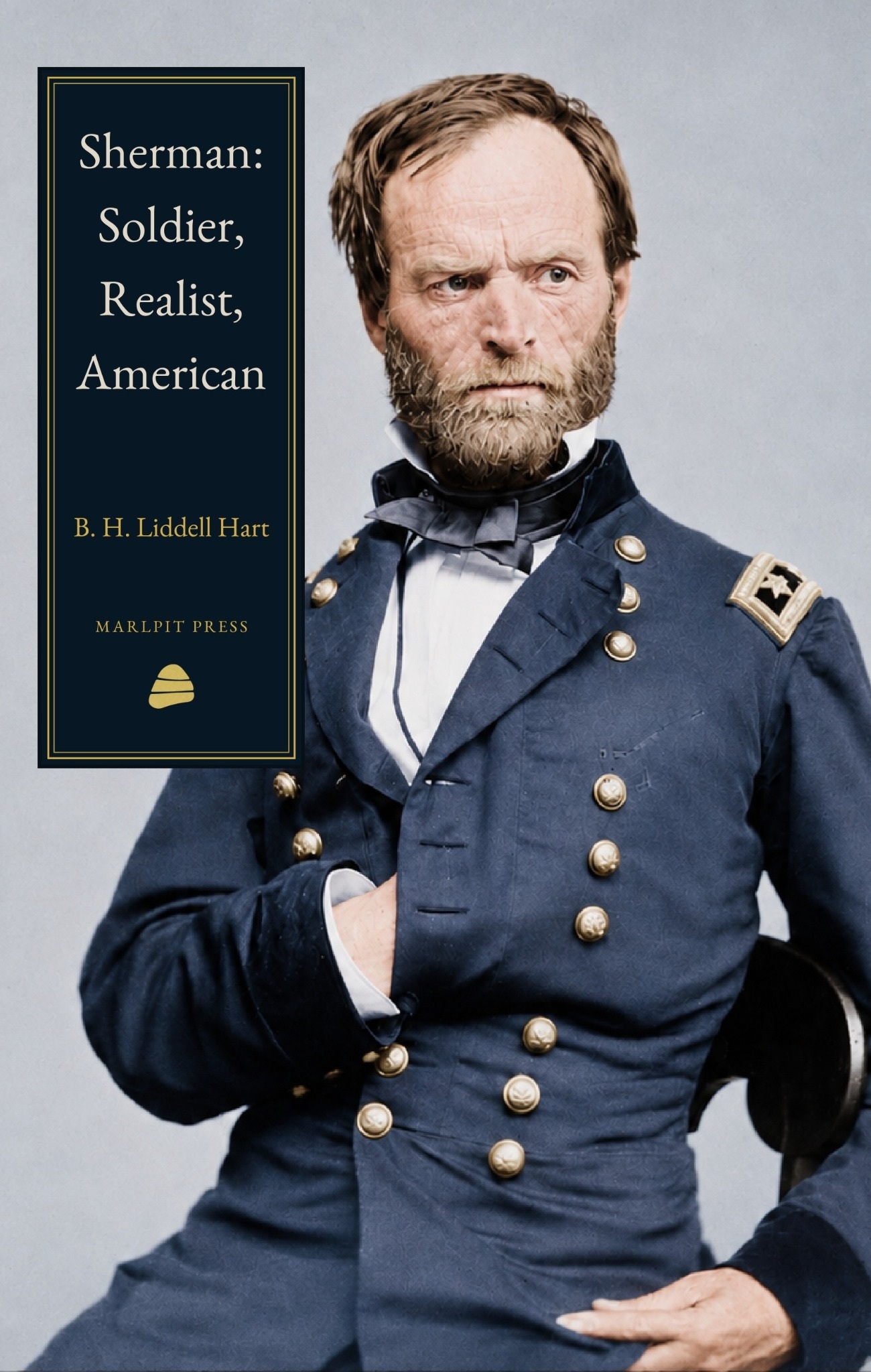
Sherman: Soldier, Realist, American therefore works on two levels. It follows Sherman from troubled early commands and recovery at Shiloh through Vicksburg, Atlanta, the March to the Sea, the Carolinas, and the peace negotiations that followed. At the same time, Hart reads those events as evidence for a theory of war built around movement, surprise, economic pressure, psychological dislocation, and striking where resistance is weakest.
Hart’s own preface described three purposes: to show the workings of Sherman’s mind, to extract lessons for modern war, and to use Sherman as a way of illuminating American character. The book is biography, but it is also an intervention in the strategic debates of Hart’s own generation.
Why 1929 matters
The timing is unusually revealing. Sherman appeared in 1929, the same year as Hart’s The Decisive Wars of History, one of the fullest early statements of what became his theory of the indirect approach. Later biographer Brian Bond judged that more of Hart’s mature strategic vocabulary came from his study of Sherman than from any other military hero.
That relationship gives the book a double historical value. It remains an important interpretation of Sherman, and it is also a document in the making of Liddell Hart. Hart saw in Sherman a commander who understood railroads, communications, economic strength, civilian morale, maneuver, and the possibility of breaking an opponent’s will without seeking battle for its own sake.
Reception and later criticism
Contemporary reviewers were often enthusiastic. John Buchan in The Spectator accepted much of Hart’s central interpretation. A. Howard Meneely called the book the best analysis of Sherman then published, and M. A. DeWolfe Howe judged it more important than a long line of earlier biographies. Other reviewers praised Hart’s research, readability, characterization, and freedom from inherited American sectional loyalties.
There were objections from the beginning. Reviewers challenged Hart’s handling of Grant, George Thomas, Shiloh, Chattanooga, and Nashville. Later historians have been more critical still. Albert Castel argued in 2003 that Hart repeatedly arranged facts and interpretations so that Sherman would validate Hart’s own strategic program.
That criticism should be taken seriously. The book is strongest when read as a classic of strategic biography rather than as a neutral final account of the Civil War. Its focus on operational design also leaves slavery, emancipation, Black military participation, refugees, occupation, and much of the social history of the war at the margins. Those limits are part of understanding what Hart set out to write.
About this Marlpit Press edition
This Marlpit Press edition returns Hart’s 1929 study to print in a clean, newly typeset format. It preserves the book as Hart wrote it while presenting the publication history and interpretive context needed to understand why it became so influential.
The edition treats the book’s strengths and its limitations as connected. Hart’s strategic lens is what makes Sherman so distinctive. It is also what leads him to compress or subordinate parts of the historical record that do not serve the argument. Readers can therefore encounter both a vivid biography of Sherman and a major text in the intellectual history of twentieth-century military strategy.
About B. H. Liddell Hart
Basil Henry Liddell Hart (1895–1970) was a British soldier, military historian, journalist, and strategist. Born in Paris and educated at St Paul’s School and Corpus Christi College, Cambridge, he entered the British Army during the First World War. His Western Front service included the Somme, where he was severely gassed in July 1916 and removed from front-line duty.
The experience of mass battle shaped his later search for alternatives to costly attrition. As a writer and military correspondent he developed the theory of the indirect approach, studied commanders from Scipio to Sherman, and became one of the twentieth century’s most widely read writers on strategy. His influence was considerable and controversial. He was knighted in 1966. Sherman belongs near the beginning of his mature strategic work and helps show how that intellectual project was formed.
Sherman: Soldier, Realist, American
Marlpit Press edition · ISBN 979-8193757573
 MARLPIT PRESSIndependent Publisher