Why Christian homeschool families still use Theras and His Town
Theras and His Town has survived for more than a century largely because it does what literature-based homeschoolers want a history book to do: it lets a child inhabit a civilization rather than merely memorize facts about it. Current Christian homeschool publishers continue to use it. Sonlight includes the book in its literature-based World History program, and Veritas Press includes it in its New Testament, Greece & Rome homeschool kits.
The fit is unusually natural. Theras learns through family life, school, Homer, music, athletics, markets, temples, craftsmanship, civic customs, geography, danger, and friendship. The book turns the ancient world into experiences a young reader can imagine and remember.
For Christian families, there is an additional reason the book has endured. Snedeker was Episcopalian, and although she treats Greek religion as a serious part of ancient life, the narrator occasionally interprets pagan devotion through a Christian theological framework. The result allows children to encounter classical pagan culture sympathetically without requiring a suspension of Christian conviction.
What happens in Theras and His Town
Theras begins the story at seven years old, the son of a prosperous Athenian citizen in the age of Pericles. Before the adventure plot takes over, the reader walks with him through ordinary Athens: school, athletics, Homer and the lyre, the Agora, the Acropolis, craftsmen, household life, worship, and the habits of the city he loves.
When his father is believed lost, Theras falls under the authority of a Spartan relative and is carried away from Athens. The world he enters is organized around military discipline, communal training, hunger, endurance, obedience, and the suppression of private preference.
Theras eventually befriends Abas, a Perioikoi shepherd boy, and the two escape. Their flight carries them through the mountains and roads of Greece, where pursuit, hunger, robbers, enslavement, wilderness, and exhaustion transform the cultural lesson into a genuine adventure. Herodotus himself eventually enters the story and helps bring Theras toward home.
Ancient Greece as living history
Snedeker’s great strength was historical inhabitation. She wanted young readers to know what a Greek boy carried to school, what he sang, how he exercised, how he understood the gods, what his city looked like, how a household functioned, and how physical geography shaped travel.
That density of ordinary detail explains why the book works so well beside a chronological study of the ancient world. It gives children mental furniture. Athens becomes streets, sounds, family habits, temples, teachers, food, sports, and familiar places rather than a chapter heading in a textbook.
Contemporary educators recognized this immediately. In 1926 children’s librarian Elva S. Smith judged that the book had value beyond entertainment and could serve as an introduction to Greek history and literature.
Athens and Sparta become two competing educations
The contrast between Athens and Sparta is the book’s central pedagogical engine. Snedeker first teaches the reader to love Athens with Theras. Only then does she remove him from it.
Her Athens is artistic, musical, conversational, religious, civic, and affectionate. Her Sparta is brave and disciplined but also coercive, militarized, austere, and suspicious of the individuality Theras takes for granted. The comparison is simplified by modern historical standards, but it is extraordinarily memorable for young readers.
For classical Christian educators, that contrast opens productive discussion about what education is for. What kind of person is a society trying to form? What place should courage, beauty, obedience, freedom, music, discipline, family, and civic duty have in a good life? The novel gives children concrete scenes through which to approach those questions.
Is Theras and His Town a Christian book?
It is best described carefully. The story is historical fiction about pagan classical Greece, not a Bible story or a novel about the early Church. Greek ritual, sacrifice, temples, Athena, and the sacred landscape are presented as real parts of Theras’s emotional world.
At the same time, Snedeker herself was Episcopalian and married an Episcopal clergyman. The narrator occasionally explains Greek religious devotion in explicitly Christian terms, suggesting that sincere prayer directed toward Athena could, in a higher sense, reach the true God.
That early-twentieth-century theological framing is one reason the book sits comfortably in Christian classical education today. It permits real imaginative sympathy with ancient Greeks while preserving a Christian hierarchy of truth. Marlpit Press preserves that feature rather than silently modernizing it.
Reading level, read-aloud use, and curriculum fit
There is no single correct grade for Theras. The book has historically been used across a broad range. A 1925 reviewer noted that younger children could follow it when read aloud, while later educators have frequently used it in upper-elementary and middle-school work. Sonlight currently sells the title, and its World History program includes it among literature selections. Veritas Press currently lists the book and includes it in its New Testament, Greece & Rome offerings.
For many families, the sweet spot is to use it as a read-aloud when children are younger or as independent historical fiction when they are ready for sustained prose and a deliberately patient opening. The later escape sequence rewards readers with much more conventional adventure after the early chapters have built the world.
It pairs especially well with Greek mythology, Herodotus, maps of the Greek world, a study of the Persian and Peloponnesian eras, or a broader history course that wants literature to supply the texture textbooks cannot.
About Caroline Dale Snedeker
Caroline Dale Snedeker (1871–1956) was an American historical novelist born in New Harmony, Indiana, and raised principally around nearby Mount Vernon. She was a great-granddaughter of social reformer Robert Owen and grew up in a family unusually saturated with education, music, historical memory, and reform movements.
Before becoming a novelist she trained seriously as a pianist and composer. That background is worth remembering in Theras, where music and Homeric song help define Athenian cultivation in contrast with Spartan austerity.
Snedeker spent years preparing herself to write about Greece. Her sister later recalled six years of study in Greek art, literature, religion, and philosophy before her first Greek novel. She later became a two-time Newbery Honor author for Downright Dencey and The Forgotten Daughter.
About this Marlpit Press edition
The documentary evidence establishes 1924 as the first publication year of Theras and His Town. Doubleday, Page & Company published the 252-page first edition and the U.S. copyright was registered on April 25, 1924. The commonly repeated 1920 date comes from later catalog metadata and should not be treated as the first-edition date.
This Marlpit Press edition is designed for readers who still use the novel in the way its earliest admirers did: as an adventure, a work of historical imagination, and a way to introduce children to ordinary life in ancient Greece.
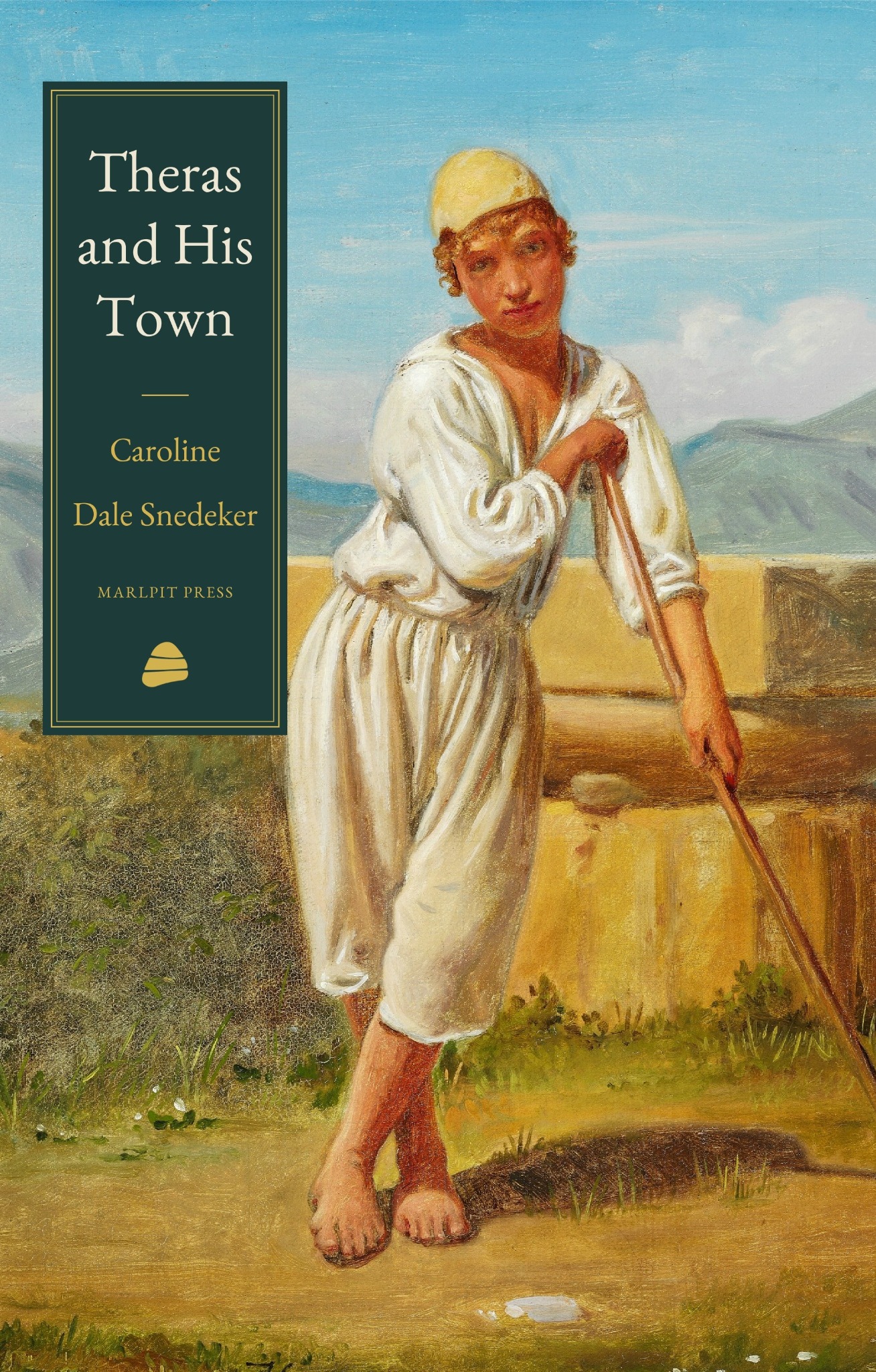
The cover and back-cover presentation are reproduced here in full so parents and teachers can inspect the edition before purchasing.
Questions Christian homeschool parents often ask
What is Theras and His Town about?
It follows a young Athenian boy in the age of Pericles whose familiar life of family, school, music, athletics, religion, and civic culture is shattered when he is taken to Sparta. He eventually escapes with his friend Abas and journeys across Greece toward home.
Is Theras and His Town a Christian book?
The story is set in pagan classical Greece, but Caroline Dale Snedeker was Episcopalian and the narrator sometimes interprets Greek religious devotion through an explicitly Christian theological framework. This has made the book especially compatible with Christian classical and homeschool study.
What age is Theras and His Town for?
It works across a wide homeschool range. Contemporary reviewers praised it as a read-aloud for younger children, while later educational use often places it in upper-elementary and middle-school study. Current Christian homeschool programs use it at different grade levels.
Does Theras and His Town compare Athens and Sparta?
Yes. The contrast is one of the book’s central teaching devices. Readers first learn to experience Athens as Theras’s home, then feel the shock of Spartan discipline, militarization, hunger, obedience, and communal training from his point of view.
When was Theras and His Town first published?
The first American edition was published in 1924 by Doubleday, Page & Company. A frequently repeated 1920 date comes from later catalog metadata and should not be used as the first-publication date without qualification.
Is Theras and His Town used in Christian homeschool curricula?
Yes. Sonlight currently sells the book and includes it in its literature-based World History program, while Veritas Press includes it in its New Testament, Greece & Rome homeschool kits and classical Christian curriculum offerings.
Christian homeschool
Why Christian Homeschoolers Read Theras and His Town
Why Snedeker’s ancient-Greece adventure still appears in Sonlight and Veritas Press, and how its Christian framing works.
Read research noteReading & curriculum
Theras and His Town: Reading Level & Curriculum Use
A practical guide to read-aloud use, independent reading, historical grade placement, Sonlight, Veritas Press, and pairing the novel with ancient history.
Read research noteAncient Greece
Athens vs. Sparta in Theras and His Town
How Snedeker turns two rival Greek societies into a memorable argument about education, freedom, discipline, beauty, courage, and belonging.
Read research note MARLPIT PRESSIndependent Publisher