 MARLPIT PRESSIndependent Publisher
Anthony Berkeley and the “Puzzle of Character”
In 1930 Anthony Berkeley attached a small manifesto to The Second Shot. The detective story, he argued, had to become more than a machine for arranging alibis and clues. Personality itself should become part of the puzzle.
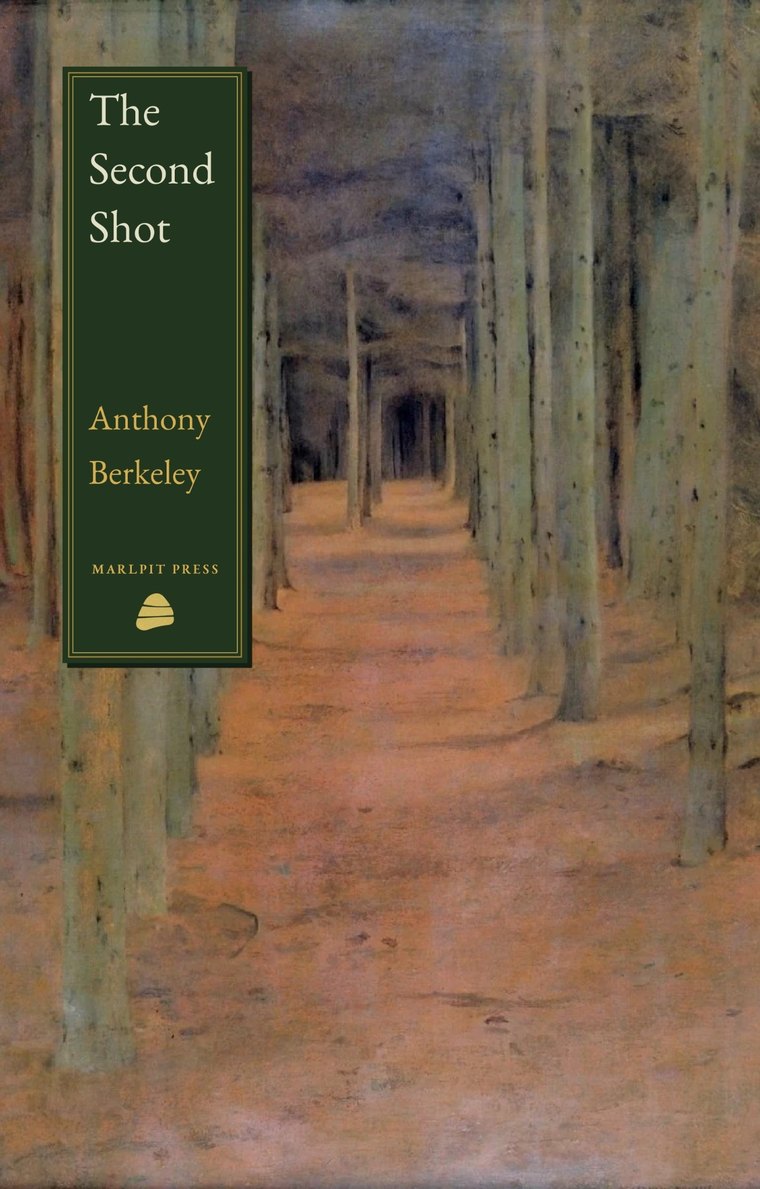
A manifesto inside a mystery
Berkeley dedicated The Second Shot to his literary agent A. D. Peters and followed the dedication with a letter-like preface. It is one of the most revealing documents of Golden Age detective fiction because Berkeley uses the opening of a commercial mystery to complain about the form that had made him successful.
He believed the clue puzzle had become too mechanical. Writers could still invent ingenious timetables, footprints, impossible rooms, and opportunities, but refinement of the machinery was not enough. The next development, he suggested, would make character itself part of the problem. His phrase was the “puzzle of character.”
What the novel tries to do
The plot gives Berkeley a laboratory. A murder game at a country-house gathering becomes a real killing, and the case turns heavily on Cyril Pinkerton, a figure whose behavior must be interpreted as carefully as the physical evidence. Roger Sheringham’s task is therefore partly to solve a crime and partly to decide what sort of person each witness and suspect actually is.
The result deliberately complicates the idea of a fair clue. A footprint can be measured. A motive cannot. A statement can be checked against a clock, but a personality has to be inferred from behavior, self-presentation, prejudice, attraction, embarrassment, and self-deception.
Did Berkeley succeed?
Contemporary reviewers disagreed. The Times Literary Supplement thought the experiment worked. Margaret I. Cole in The Spectator thought it failed at the crucial point because Pinkerton was not psychologically convincing enough to support the weight Berkeley placed on him.
Later critics often admired the manifesto more than the execution. That is not a reason to dismiss the book. Failed or partial experiments can be historically clearer than polished solutions. The Second Shot shows Berkeley discovering the limitations of the classical whodunit while still writing one.
The bridge to Francis Iles
The chronology makes the experiment especially important. Berkeley had published The Poisoned Chocolates Case in 1929, one of the great demonstrations that a single set of clues can support several ingenious solutions. The Second Shot followed in 1930. In 1931, as Francis Iles, he published Malice Aforethought.
The Iles novel takes a much more radical step. Instead of asking readers to identify the murderer, it turns the murderer into the center of the narrative and shifts suspense toward psychology, consequence, and exposure. In that sense, The Second Shot is an evolutionary link. Berkeley first announces the destination while still inside the old form, then reaches it by changing forms.
Why it matters to the history of the Golden Age
Berkeley was not an outsider attacking detective fiction. He was one of its most inventive practitioners and a central figure in the Detection Club. His criticism therefore came from the middle of the Golden Age establishment.
That double role makes the “puzzle of character” more than a clever phrase. It records a moment when one of the architects of the clue puzzle was already asking what crime fiction would have to become after the puzzle had been perfected.
Research basis
This note draws on primary and scholarly material assembled for the Marlpit Press edition and research dossier.
- Anthony Berkeley, prefatory letter to The Second Shot
- Times Literary Supplement review
- Margaret I. Cole in The Spectator
- Martin Edwards and later histories of Golden Age crime fiction