The mystery
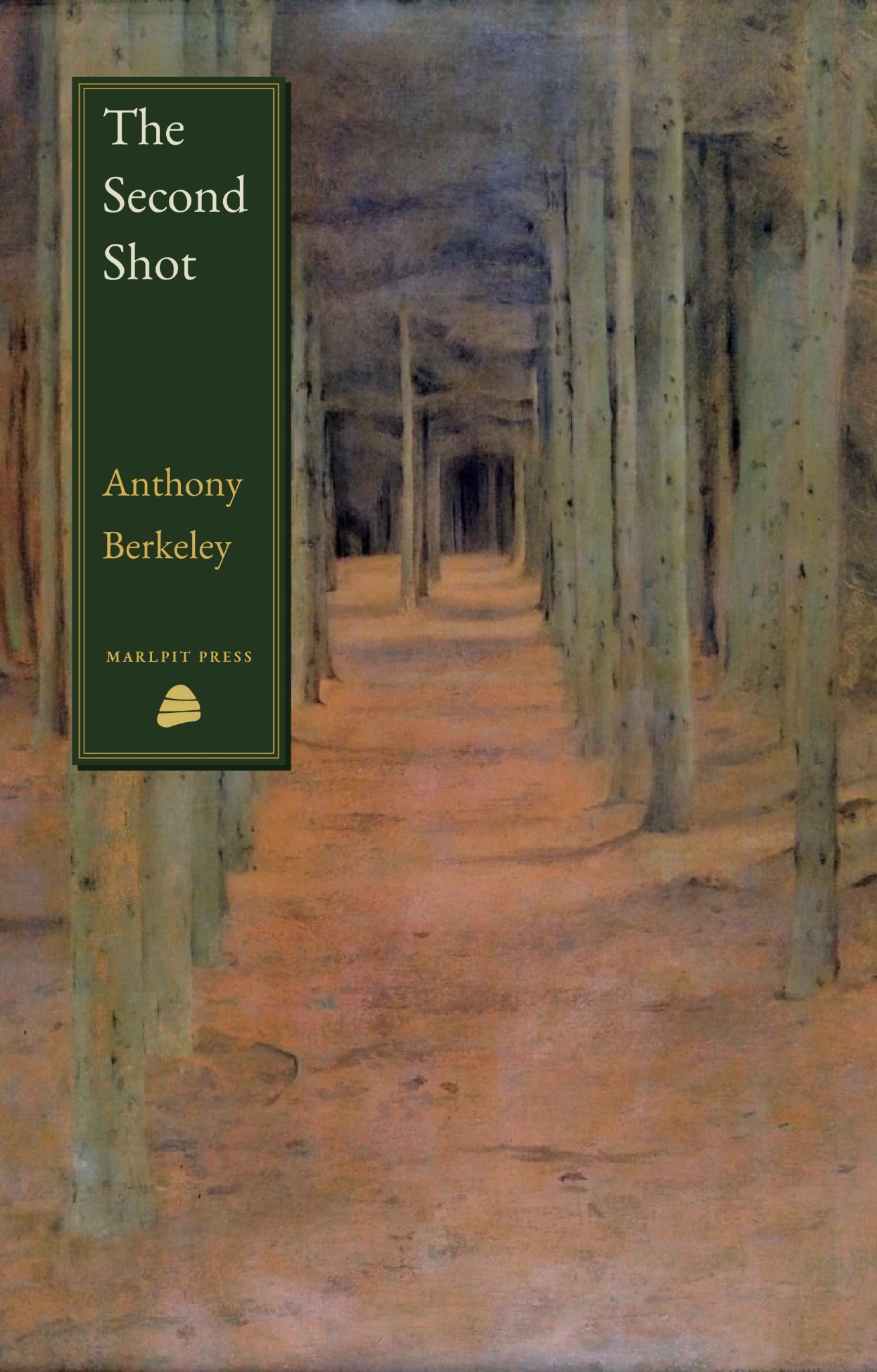
A house party at Minton Deeps has gathered for an unusual amusement: a carefully staged murder devised by detective novelists to test their friends’ powers of deduction. Then two shots are heard and Eric Scott-Davies is found dead in the woods. The game has become real.
Suspicion settles on Cyril Pinkerton. He had quarreled with the dead man, had reason to resent him, and has difficulty accounting for his movements. More troublingly, the police discover him secretly burying a manuscript containing his own account of what happened at Minton Deeps. Roger Sheringham enters a case of shifting alibis, romantic rivalries, competing explanations, and evidence that seems to change meaning depending on the character through whom it is viewed.
That structure makes The Second Shot one of Berkeley’s most revealing experiments. The mechanical detective problem is still elaborate, but the novel keeps asking whether motives and personalities can be treated as evidence with the same confidence as footprints, clocks, and maps.
Berkeley’s “puzzle of character”
The book is famous for the manifesto attached to it. In a prefatory letter to his literary agent A. D. Peters, Berkeley argued that the detective story had to move beyond an endless refinement of alibis, clues, timetables, and opportunities. He wanted personality to become part of the problem. His compact phrase for the goal was a “puzzle of character.”
Contemporary reviewers immediately understood the ambition. The Times Literary Supplement thought Berkeley had largely succeeded. Margaret I. Cole in The Spectator was much more skeptical, arguing that the psychological experiment failed where it mattered most, in the construction of Pinkerton himself. Later critics often reached a similar judgment: the manifesto is more revolutionary than the novel.
That tension is exactly what makes the book historically interesting. The Second Shot appeared after The Poisoned Chocolates Case and just before Berkeley, writing as Francis Iles, published Malice Aforethought in 1931. In the Iles novels he would abandon the conventional whodunit far more decisively. The Second Shot captures the transition while it is happening.
Publication and place in the Sheringham series
Hodder & Stoughton published the British edition in 1930. The American Doubleday, Doran Crime Club edition followed in 1931. It is the sixth Roger Sheringham novel, following The Poisoned Chocolates Case and preceding Top Storey Murder.
The timing also places it at the center of Berkeley’s influence on Golden Age crime writing. He was a driving force behind the Detection Club, the celebrated group that brought together leading British detective novelists. Yet even while helping institutionalize the classic puzzle tradition, he was increasingly dissatisfied with its limits. The Second Shot is the clearest place where that dissatisfaction becomes part of the book itself.
About this Marlpit Press edition
This edition presents Berkeley’s complete 1930 novel in a newly typeset format, preserving the book’s unusual prefatory argument and the structure that makes the experiment intelligible.
The aim is straightforward: readable typography, a clean text, and enough bibliographic and critical context to show why The Second Shot matters inside Berkeley’s career. It belongs to the history of the Golden Age puzzle, but it also points toward the psychological crime novel Berkeley was about to write under another name.
About Anthony Berkeley
Anthony Berkeley Cox (1893–1971) published detective fiction as Anthony Berkeley and psychological crime novels as Francis Iles. Educated at Sherborne and University College, Oxford, he served during the First World War and later became one of the most inventive and argumentative figures of interwar crime writing.
His Roger Sheringham novels repeatedly tested the assumptions of detective fiction, most famously in The Poisoned Chocolates Case. Under the Iles name, Malice Aforethought and Before the Fact helped establish the inverted and psychological crime novel. Berkeley was also central to the founding of the Detection Club. His career makes The Second Shot especially valuable: the book stands directly between his mastery of the clue puzzle and his more radical experiments with criminal psychology.
The Second Shot
Marlpit Press edition · ISBN 979-8192967034
 MARLPIT PRESSIndependent Publisher