The mystery
A powerful financier is found dead behind the closed doors of his private office, his throat cut and the circumstances of the murder seemingly impossible. Sir Albert Lines-Bower had money, secrets, enemies, and interests reaching far beyond the walls of his business empire. Scotland Yard has suspects, evidence, and political pressure. What it lacks is an explanation.
Colonel Anthony Gethryn follows the case from the office into London nightclubs, criminal hideouts, disappearances, kidnapping, and increasingly violent territory. The novel begins with the expectations of a Golden Age clue puzzle and keeps widening until it has absorbed material more typical of an adventure thriller.
That unstable mixture is one reason The White Crow matters in Philip MacDonald’s career. It takes the civilized puzzle machinery associated with his first Gethryn novel, The Rasp, and pushes hatred, danger, lust, melodrama, and sensational action much closer to the center.
A 1928 success that later disappeared
William Collins, Sons & Co. published The White Crow in Britain in 1928, and The Dial Press issued it in the United States the same year. It was MacDonald’s second Anthony Gethryn novel and arrived when his reputation was rising quickly.
The contemporary reception was strong. The New Yorker recommended it. The Times Literary Supplement found the story unusual and thought MacDonald kept even its violence within the bounds of probability. The Nation and Athenaeum considered it better written and more exciting than most detective stories. It also appeared among the fiction titles reported as heavily demanded at the Times Book Club.
The book had a long afterlife. Collins reprinted it in inexpensive hardcover editions in the 1930s, Fontana revived it in paperback in 1958, and crime novelist Michael Gilbert selected it for Hodder & Stoughton’s Classics of Detection and Adventure series in 1966. Its present obscurity is therefore much newer than the novel itself.
A note for modern readers
The solution also contains racial assumptions and language that are offensive and historically significant. These are not confined to a stray remark that can be detached from the novel. They enter the mechanism of the plot and the meaning of the title. A modern edition should not disguise that fact.
Marlpit Press leaves the historical novel intact while giving readers enough context to approach it knowingly. The difficulty is part of the book’s history: a once highly regarded crime novel can remain formally inventive while also revealing prejudices embedded in the culture that produced it.
About this Marlpit Press edition
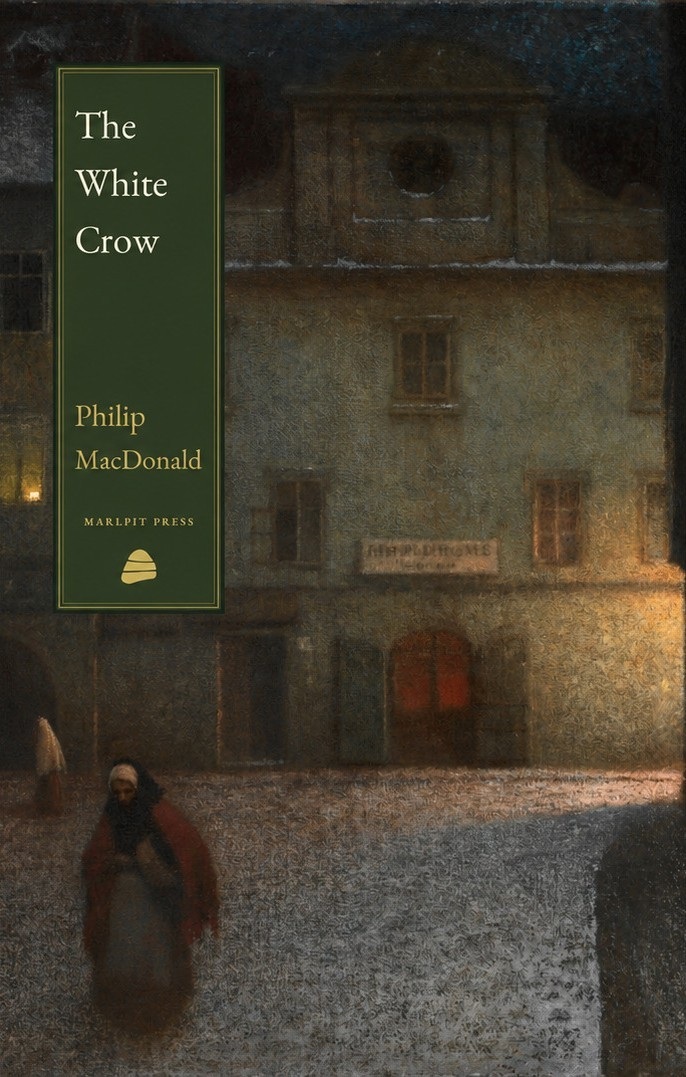
This edition restores The White Crow as a complete, newly typeset novel for readers interested in Philip MacDonald, Anthony Gethryn, and the more violent edge of Golden Age detective fiction.
The accompanying material identifies the British and American publication history, places the novel after The Rasp, and explains why it occupies such a revealing position between puzzle mystery and thriller. The goal is to make the book legible as a historical work as well as an entertainment.
About Philip MacDonald
Philip MacDonald (1900–1980) came from an extraordinary literary family. His father Ronald MacDonald was a novelist and playwright, his mother Constance Robertson an actress, and his grandfather was the Scottish novelist and fantasist George MacDonald. The strongest surviving evidence places Philip’s birth in London on 5 November 1900, although reference works have repeated several conflicting years.
MacDonald became a successful novelist and screenwriter whose books include The Rasp, Murder Gone Mad, Warrant for X, and The List of Adrian Messenger. He also built a substantial Hollywood career and twice won the Mystery Writers of America’s Edgar Award for Best Short Story. His biography retains genuine uncertainties, including a traditional account of First World War service that sits awkwardly beside the best evidence for his birth date.
The White Crow
Marlpit Press edition · ISBN 979-8192927311
 MARLPIT PRESSIndependent Publisher