 MARLPIT PRESSIndependent Publisher
George Salmon’s Private Judgment Argument Against Infallibility
Salmon’s most durable argument asks whether an infallible Church can actually remove private judgment, or merely move it to a different level.
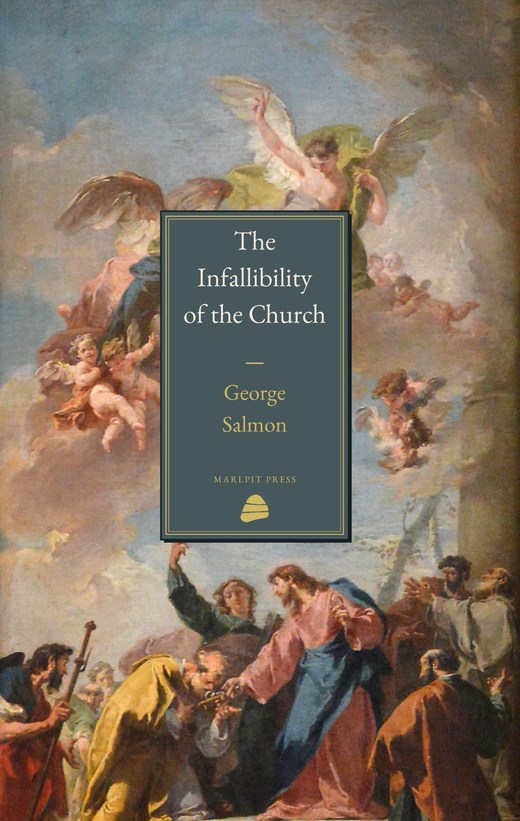
Read the book
The apologetic promise Salmon is targeting
A common nineteenth-century Catholic argument presented Rome as an escape from the uncertainty of Protestant private interpretation. Scripture requires interpretation, sincere readers disagree, and an infallible living Church promises a final rule.
Salmon does not need to show that Church authority is useless. He asks whether the contrast between “private judgment” and “submission to infallibility” is as clean as the apologetic claim suggests.
Judgment before submission
A prospective convert must judge that Christ founded an infallible teaching Church, judge that the Roman communion is that Church, evaluate the historical and scriptural evidence for its credentials, identify the body or office in which the charism resides, and often decide whether a particular teaching act satisfies the conditions of infallibility.
The believer therefore cannot reach the supposed refuge from private judgment without first using private judgment to identify the refuge.
First-order and second-order certainty
Salmon’s strongest formulation distinguishes the truth of an authority from the believer’s knowledge of that authority. Even if a Church teaches a doctrine infallibly, the believer’s recognition that this is the infallible Church and that this act is protected may still depend on ordinary historical and rational evidence.
The argument therefore presses second-order questions of recognition and interpretation.
The Catholic reply
A Catholic can answer that rational submission to an authoritative teacher is perfectly compatible with antecedent personal reasoning. The believer’s recognition can be fallible even if the authority’s definitive teaching is objectively infallible.
That reply weakens any claim that Catholicism abolishes private judgment altogether, while leaving open the larger theological claim that an infallible authority genuinely exists.
Research basis
This note draws on Salmon’s 1888 book, contemporary reception, Catholic replies, Trinity College Dublin and Royal Society biographical material, and the source-critical George Salmon research dossier prepared for the Marlpit Press edition.
- George Salmon, The Infallibility of the Church (John Murray, 1888)
- George Salmon’s 1888 preface
- First Vatican Council, Pastor Aeternus (1870)
- Alfred Plummer, The Churchman (January 1889)
- Jeremiah Murphy, Irish Ecclesiastical Record (1901–1902)
- Catholic Encyclopedia, “Infallibility”
- B. C. Butler, The Church and Infallibility (1954)
Continue reading
The Infallibility of the Church · George Salmon biography · Christianity & Theology · All research notes