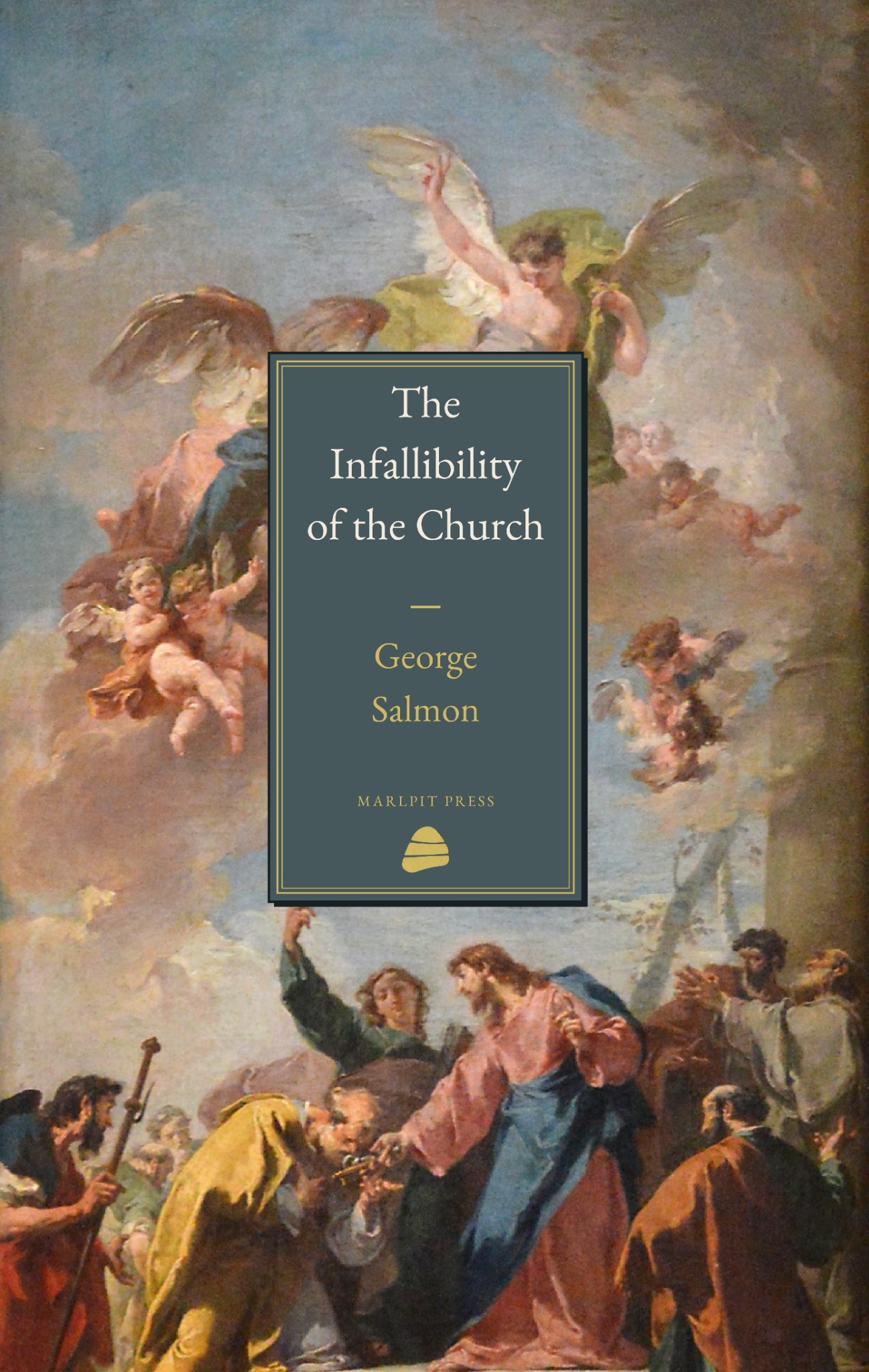
A classic Protestant critique of Catholic infallibility
The Infallibility of the Church is one of the most durable nineteenth-century Protestant examinations of Roman Catholic claims to an infallible teaching authority. Salmon’s central concern is epistemological as much as historical: what does a claim to an infallible Church actually do for the believer who must identify, recognize, and interpret that authority?
The result is part Anglican polemic, part historical theology, part handbook for divinity students, and part sustained inquiry into religious authority.
The private judgment argument
Salmon’s best-known argument begins with the Catholic apologetic promise that submission to an infallible Church can rescue the believer from the uncertainty of private interpretation.
He asks what must happen before that submission is possible. A convert must judge that Christ founded an infallible teaching Church, judge that the Roman communion is that Church, identify the organ in which infallibility resides, assess the historical and scriptural evidence, and often determine whether a particular act satisfies the conditions of infallibility.
The force of the argument is modest but persistent: accepting an authority can relocate the object of judgment, but it cannot make the believer’s antecedent reasoning disappear.
Vatican I and the practical problem of an infallible guide
Salmon wrote most of these lectures around 1870, precisely when the First Vatican Council defined papal infallibility in Pastor Aeternus. His target is often the apologetic image of a living, accessible, infallible guide capable of resolving Christian uncertainty.
He therefore presses a practical question alongside the formal dogmatic one: if such a guide exists, how easily can the faithful determine when and where it has spoken? Disputes over councils, papal statements, Gallican and ultramontane theories, and the conditions of an ex cathedra definition become evidence in that larger argument.
Circularity, Scripture, tradition, and the rule of faith
One lecture attacks a simple circular argument in which the Church authenticates Scripture while Scripture authenticates the Church. Salmon’s deeper point is that mutually supporting authorities still require some independent evidential content if the reasoning is to avoid becoming a disguised premise.
He applies the same pressure to appeals to tradition. The Fathers disagree, schools of interpretation diverge, and later doctrinal systems must decide which witnesses count and how earlier evidence should be harmonized. For Salmon, a tradition cannot function as evidence until the rules by which it is interpreted are made explicit.
Newman and doctrinal development
John Henry Newman stands in the background of the book as the great intellectual symbol of conversion from Anglicanism to Rome. Salmon understands why a theory of doctrinal development is needed: later Catholic doctrines often do not appear in the earliest sources in identical conceptual form.
His challenge is falsifiability. If absence, novelty, or reversal can always be explained as organic development, what historical evidence could ever count against a claimed development? Catholic replies rightly note that Newman himself distinguished genuine development from corruption. Salmon’s lasting pressure is therefore on the criteria used to make that distinction.
The seat of infallibility: pope, councils, and the Church
Before Vatican I, Catholic theologians disagreed over how infallibility was distributed between pope, bishops, and councils. Salmon gives special attention to Gallican theories that resisted stronger papal claims.
His argument is historical and constitutional: if an infallible authority was essential to Christian certainty from the beginning, why did its precise location and conditions remain disputed for so long?
Peter, Rome, and papal primacy
Salmon carefully separates claims that are often bundled together: Peter’s prominence among the apostles, Peter’s presence and death at Rome, a Roman episcopal office, succession to Petrine prerogatives, universal papal jurisdiction, and papal infallibility.
His method is to insist that each stronger claim requires additional evidence. Historical support for Peter’s Roman connection does not by itself establish the full later papal constitution.
Honorius, Galileo, councils, and historical stress tests
Salmon does not write a continuous history of the papacy. He uses history adversarially, almost like legal cross-examination, selecting episodes that place a theory of infallibility under maximum strain.
The cases of Popes Liberius, Honorius, and Zosimus matter because they involve doctrinal crises. Honorius is especially important because the Sixth Ecumenical Council anathematized him and later popes confirmed the council. Salmon also discusses Galileo and the practical problem of identifying which councils count as ecumenical and binding.
A careful modern reading has to distinguish institutional error from a direct counterexample to the narrow conditions of Vatican I. Salmon’s examples are often strongest against broad apologetic rhetoric about a uniformly clear Roman guide and more qualified against the technical doctrine of papal infallibility.
A book born from the crisis of 1870
The first edition appeared in 1888, but Salmon’s own preface says that the majority of the lectures were written around 1870. That timing matters.
The First Vatican Council defined papal infallibility in July 1870. At almost the same moment, the Church of Ireland was passing through disestablishment and reconstructing its institutional life. Salmon, already Regius Professor of Divinity at Trinity College Dublin, was teaching future Church of Ireland clergy how to think about authority while both Roman Catholic and Irish Anglican structures were being redefined.
From Divinity School lectures to the 1888 John Murray edition
The published book grew out of lectures delivered in the Divinity School of the University of Dublin. Salmon had not originally written most of them for publication.
John Murray issued the first edition in London in 1888, with xxvii pages of preliminary matter and 495 pages of main text. The book’s twenty-three lectures move from the logic of authority and private judgment through Scripture, tradition, councils, Petrine claims, the growth of Roman supremacy, papal infallibility, and temporal power.
Contemporary reception
The strongest securely recovered contemporary review is Alfred Plummer’s six-page notice in The Churchman in January 1889. Plummer praised the book’s usefulness for students, its liveliness, its logical pressure, and Salmon’s freedom from the usual rancor of religious controversy.
A John Murray advertisement preserved favorable extracts from John Bull and The Church Times. The latter called the book one of the ablest works it had encountered on the Roman controversy. Because those excerpts survive in publisher advertising, they should be treated as selected quotations rather than as complete reviews.
Catholic replies and the book’s long afterlife
Catholic writers treated Salmon as a serious opponent. Jeremiah Murphy answered him in a seven-part series in the Irish Ecclesiastical Record in 1901–1902. The Catholic Encyclopedia later described Salmon as one of the subtlest recent opponents of infallibility.
In the 1950s an abridged Salmon returned to circulation. Basil Christopher Butler reviewed it in The Tablet and then wrote The Church and Infallibility in 1954 as a sustained Catholic reply. That twentieth-century revival shows how long Salmon remained active in Catholic-Protestant apologetics.
About George Salmon
George Salmon (1819–1904) was an Irish mathematician, Church of Ireland theologian, and university leader. Educated at Trinity College Dublin, he first achieved international distinction through major works in analytic and algebraic geometry.
He was elected a Fellow of the Royal Society in 1863, received the Royal Medal in 1868, and was awarded the Copley Medal in 1889. In theology he became Regius Professor of Divinity at Trinity College Dublin in 1866 and Provost of Trinity in 1888.
His mathematical training remained visible in his theology: definitions are separated, assumptions exposed, and historical cases used as stress tests for general claims.
How to read Salmon today
Salmon is strongest where he asks second-order questions about authority: who identifies the infallible organ, how the believer recognizes a definitive act, how circular appeals are avoided, and what historical evidence would count against a theory of development.
Some historical arguments require qualification because Catholic doctrine does not claim that every papal statement, Roman decision, catechism, or administrative act is infallible. The most fruitful modern reading preserves Salmon’s logical pressure while testing each historical case against the narrower claims actually defined by Catholic doctrine.
Research
Research & controversy notes
Authority & epistemology
George Salmon’s Private Judgment Argument Against Infallibility
Why submission to an infallible Church still requires judgments about which Church, which authority, and which acts are infallible.
Read research noteVatican I
George Salmon on Vatican I and Papal Infallibility
How Salmon tests the apologetic promise of an infallible guide against Pastor Aeternus, Gallicanism, ultramontanism, and the practical recognition of ex cathedra teaching.
Read research noteHistorical case study
George Salmon, Pope Honorius, and Papal Infallibility
Why Honorius became one of Salmon’s most important historical stress tests, and how Catholic replies distinguish the case from an ex cathedra definition.
Read research noteNewman & development
George Salmon on Newman and Doctrinal Development
Salmon’s challenge to theories of doctrinal development: what evidence could count against a claimed development, and how are development and corruption distinguished?
Read research noteReception & controversy
How Catholics Answered George Salmon
From Jeremiah Murphy and the Catholic Encyclopedia to B. C. Butler’s 1954 book-length reply, Salmon remained a serious target in Catholic apologetics.
Read research note MARLPIT PRESSIndependent Publisher