 MARLPIT PRESSIndependent Publisher
Mathematician, theologian, and university leader
George Salmon was one of the most intellectually wide-ranging Irish academics of the nineteenth century. He built an international reputation in mathematics before becoming a major Church of Ireland theologian and, finally, Provost of Trinity College Dublin.
The exact place of his birth is disputed in the sources. He was born on 25 September 1819, traditionally reported as Cork, while other evidence points to Dublin. His schooling was strongly associated with Cork.
Trinity College Dublin
Salmon entered Trinity College Dublin while still very young. He won a classical scholarship, became first senior moderator in mathematics, and was elected a Fellow of Trinity in 1841 before his twenty-second birthday.
His early academic training made him a formidable problem solver. That habit later shaped his theology, where he repeatedly reduces broad disputes to their governing propositions and tests those propositions for consistency.
An international mathematical reputation
For roughly the first half of his scholarly career Salmon was known primarily as a mathematician. His major books included A Treatise on Conic Sections, A Treatise on Higher Plane Curves, Lessons Introductory to the Modern Higher Algebra, and A Treatise on the Analytic Geometry of Three Dimensions.
He was elected a Fellow of the Royal Society in 1863, received the Royal Medal in 1868, and was awarded the Copley Medal in 1889.
From mathematics to theology
Salmon was ordained deacon in 1844 and priest in 1845 in the Church of Ireland. Theology gradually occupied more of his attention, though the mathematical work continued to circulate widely.
He became Regius Professor of Divinity at Trinity College Dublin in 1866, placing him at the center of the education of future Church of Ireland clergy.
Richard Whately and the Oxford Movement
A major intellectual influence was Richard Whately, Archbishop of Dublin, who appointed Salmon an examining chaplain in 1852. Both men belonged to a rational, strongly Protestant Anglican tradition deeply suspicious of the Oxford Movement and the movement of educated Anglicans toward Rome.
Salmon contributed to Cautions for the Times and wrote in anti-Roman controversial settings long before Vatican I. The infallibility lectures therefore grew from a mature program rather than from a sudden reaction in 1870.
The crisis of 1870
The majority of the lectures later published as The Infallibility of the Church were written around 1870. The timing placed Salmon in the middle of two major institutional changes.
The First Vatican Council defined papal infallibility in July 1870, while the Church of Ireland was passing through disestablishment. Salmon was simultaneously thinking about Roman authority and helping his own church reconstruct its institutional life.
The Infallibility of the Church
Salmon’s 1888 book is his most enduring work of anti-Roman controversy. Its strongest arguments ask how an infallible authority is identified, whether submission can eliminate private judgment, how circular appeals to Scripture and Church can be avoided, and whether the historical record supports the apologetic picture of a continuously available infallible guide.
His method is more analytical than merely denunciatory. He separates claims about councils, papal statements, Petrine succession, doctrinal development, and historical errors, then asks exactly what would be needed to establish each conclusion.
Provost of Trinity
In 1888 Salmon became Provost of Trinity College Dublin, the same year the first edition of The Infallibility of the Church appeared from John Murray.
He remained Provost until his death in 1904.
Legacy
Salmon’s mathematical work secured him a permanent place in nineteenth-century science, while The Infallibility of the Church gave him a long afterlife in Protestant-Catholic apologetics.
Catholic writers repeatedly answered him, from Jeremiah Murphy at the beginning of the twentieth century to B. C. Butler’s book-length reply in 1954. That continuing rebuttal history is evidence of how seriously his arguments were taken.
Marlpit Press edition
All books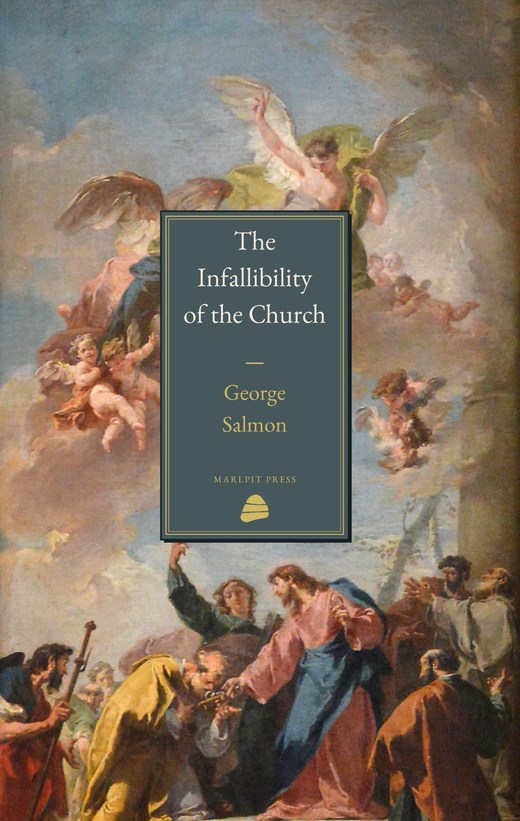
Research notes
All notesGeorge Salmon’s Private Judgment Argument Against Infallibility
Why submission to an infallible Church still requires judgments about which Church, which authority, and which acts are infallible.
Read research noteGeorge Salmon on Vatican I and Papal Infallibility
How Salmon tests the apologetic promise of an infallible guide against Pastor Aeternus, Gallicanism, ultramontanism, and the practical recognition of ex cathedra teaching.
Read research noteGeorge Salmon, Pope Honorius, and Papal Infallibility
Why Honorius became one of Salmon’s most important historical stress tests, and how Catholic replies distinguish the case from an ex cathedra definition.
Read research noteGeorge Salmon on Newman and Doctrinal Development
Salmon’s challenge to theories of doctrinal development: what evidence could count against a claimed development, and how are development and corruption distinguished?
Read research noteHow Catholics Answered George Salmon
From Jeremiah Murphy and the Catholic Encyclopedia to B. C. Butler’s 1954 book-length reply, Salmon remained a serious target in Catholic apologetics.
Read research note