 MARLPIT PRESSIndependent Publisher
New Harmony, family, and education
Caroline Dale Parke Snedeker was born March 23, 1871, in New Harmony, Indiana, according to the strongest contemporary and scholarly evidence, and grew up principally in nearby Mount Vernon. She was a great-granddaughter of Robert Owen, the social reformer associated with the New Harmony experiment.
Her childhood belonged to a family culture unusually rich in education, historical memory, music, books, and reform movements. Another branch of the family connected her to Joseph Neef, the Alsatian-American educational reformer and disciple of Pestalozzi.
A musician before she was a novelist
Snedeker trained seriously in piano and composition. Her family moved to Cincinnati for better musical education, and she graduated with honors from the College of Music after study under Albino Gorno. She later pursued private study in New York with Bruno Oscar Klein.
That background helps explain the importance of music in her Greek fiction. In Theras and His Town, the lyre and Homeric song are not incidental details. Musical education becomes one of the qualities by which Snedeker defines cultivated Athenian life.
Christian identity and marriage
In 1903 Caroline Parke married the Reverend Charles H. Snedeker, an Episcopal clergyman. A contemporary biographical entry identifies Caroline herself as Episcopalian, one of the relatively few personal convictions she recorded directly in a reference work during her lifetime.
That religious identity matters when reading Theras. Snedeker takes ancient pagan devotion seriously, but the narrator occasionally interprets it through a Christian theological framework. The feature belongs to the original work and helps explain its later compatibility with Christian classical education.
Six years learning Greece
Ancient Greece was Snedeker’s earliest great literary obsession. Her first novel, The Coward of Thermopylae, appeared in 1911 and was reworked for younger readers as The Spartan in 1912.
Her sister later recalled that Snedeker studied Greek art, literature, religion, and philosophy for six years before producing her first Greek book. Contemporary evidence confirms her intense interest in Greek culture while also making clear that she was not a classical philologist who read ancient Greek fluently.
Why she wrote Theras and His Town
Theras and His Town emerged from demonstrated demand. The standard scholarly biography states that the success of Snedeker’s earlier Greek fiction produced a request for a treatment suitable for younger children.
Her solution was inspired: instead of centering another adult soldier or famous battle, she created a child whose ordinary life could carry the historical instruction naturally. School explained education. Walks explained Athens. Religion explained Greek worship. Exile explained Sparta. Escape turned geography into adventure.
Newbery recognition and later career
Snedeker went on to write a substantial body of historical fiction about Greece, Rome, early Christianity, New Harmony, and other periods. Her novels Downright Dencey and The Forgotten Daughter received Newbery Honors in 1928 and 1934 respectively.
Her distinctive gift was historical inhabitation: showing children what it might feel like to wake up inside another society. That talent explains why Theras, despite its patient and sometimes didactic opening, has had such an unusually durable educational afterlife.
Marlpit Press edition
All books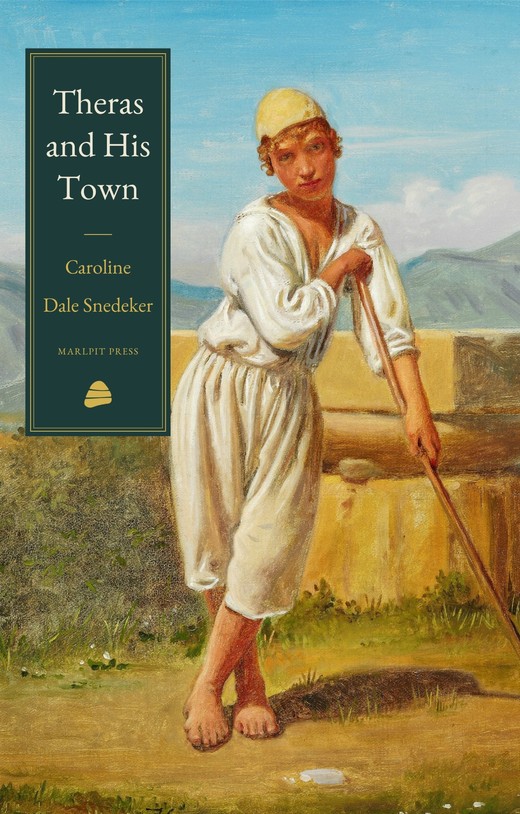
Research notes
All notesWhy Christian Homeschoolers Read Theras and His Town
Why Snedeker’s ancient-Greece adventure still appears in Sonlight and Veritas Press, and how its Christian framing works.
Read research noteTheras and His Town: Reading Level & Curriculum Use
A practical guide to read-aloud use, independent reading, historical grade placement, Sonlight, Veritas Press, and pairing the novel with ancient history.
Read research noteAthens vs. Sparta in Theras and His Town
How Snedeker turns two rival Greek societies into a memorable argument about education, freedom, discipline, beauty, courage, and belonging.
Read research note