 MARLPIT PRESSIndependent Publisher
Oak Park, journalism, and the First World War
Ernest Miller Hemingway was born in Oak Park, Illinois, on July 21, 1899. He did not attend college. After graduating from high school in 1917, he joined the Kansas City Star, where brief newspaper reporting became his first professional apprenticeship in prose.
In 1918 Hemingway joined the American Red Cross ambulance service and went to Italy. On July 8, while distributing supplies to Italian soldiers near Fossalta di Piave, he was badly wounded by a mortar explosion and additional gunfire. He was eighteen. During his recovery in Milan he fell in love with the American nurse Agnes von Kurowsky, a relationship that later supplied part of the emotional material he transformed into fiction.
Paris and the making of a literary reputation
Hemingway married Hadley Richardson in 1921 and moved to Paris, where he worked for the Toronto Star and entered a literary circle that included Gertrude Stein, Ezra Pound, James Joyce, F. Scott Fitzgerald, Ford Madox Ford, Sylvia Beach, and John Dos Passos.
In Our Time appeared in American form in 1925, followed by The Sun Also Rises in 1926 and Men Without Women in 1927. By the time Hemingway began sustained work on A Farewell to Arms in 1928, he was already famous in literary circles and was looking for a novel capable of carrying his method onto a larger tragic scale.
A Farewell to Arms
Hemingway wrote the novel across Paris, Key West, Piggott, Kansas City, and Wyoming. The book transformed elements of his 1918 experience rather than reproducing them. He had never witnessed the 1917 retreat from Caporetto and researched it deliberately, collecting maps, photographs, aerial views, and other material to reconstruct the Italian collapse.
The novel was published by Charles Scribner’s Sons on September 27, 1929, after serialization in Scribner’s Magazine. It became Hemingway’s first enormous commercial success and was greeted by a largely enthusiastic critical response. The surviving manuscripts also reveal the severity of his revision. Hemingway later remembered rewriting the last page thirty-nine times; the archive preserves forty-four handwritten ending drafts, while other counts identify about forty-seven variants.
Later career and legacy
Hemingway continued to move between journalism, travel, war reporting, sport, and fiction. Death in the Afternoon appeared in 1932, For Whom the Bell Tolls in 1940, and The Old Man and the Sea in 1952. The last of these won the Pulitzer Prize in 1953. Hemingway received the Nobel Prize in Literature in 1954 for his mastery of narrative and his influence on contemporary prose.
He died in Ketchum, Idaho, on July 2, 1961. The Ernest Hemingway Collection at the John F. Kennedy Presidential Library now preserves the great majority of the surviving manuscript archive, making it possible to study in unusual detail the drafts, correspondence, research material, and repeated revisions behind the apparently effortless surface of his prose.
Marlpit Press edition
All books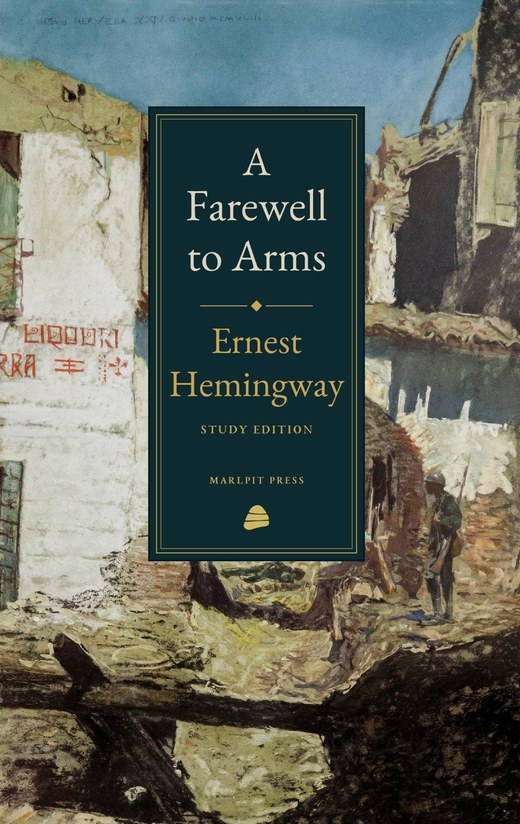
Research notes
All notesIs A Farewell to Arms Autobiographical?
What Hemingway took from his 1918 wound and Agnes von Kurowsky, what came from later life, and what he invented for Frederic and Catherine.
Read research noteDid Hemingway Witness the Retreat from Caporetto?
Why the novel’s most convincing military sequence describes an event Hemingway never saw, and how he researched the Italian disaster of 1917.
Read research noteHow Many Endings Did Hemingway Write?
Hemingway said thirty-nine. The archive contains forty-four handwritten ending drafts, while later editions and exhibitions count about forty-seven variants.
Read research note