 MARLPIT PRESSIndependent Publisher
Theodore Roosevelt as Author of His Own Legend
Einstein’s most modern insight may be that Roosevelt was both a historical actor and an unusually active editor of the story future generations would tell about him.
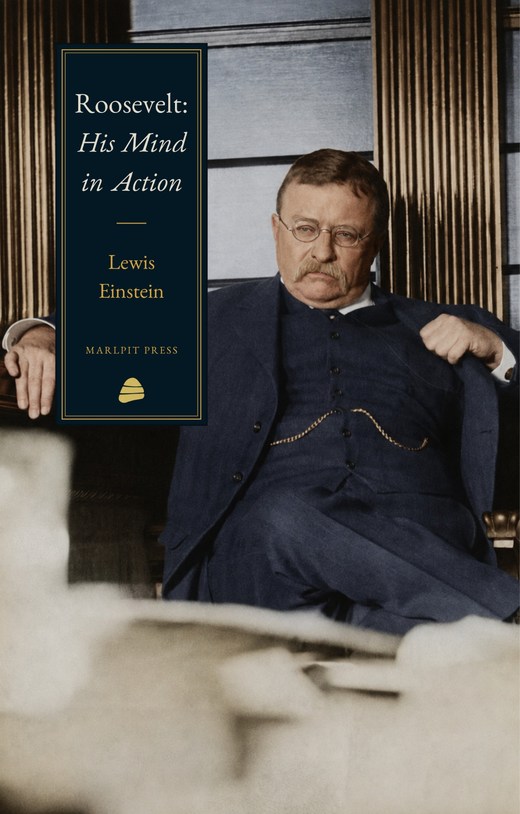
Roosevelt and posterity
Einstein repeatedly notices how conscious Roosevelt was of historical memory. Roosevelt was a historian himself, wrote prolifically, preserved explanations of controversial decisions, and knew that private letters could later become source material.
That makes reputation part of the political story rather than a separate afterlife.
The Autobiography as an action
Einstein does not treat Roosevelt’s Autobiography as a transparent record. He asks why Roosevelt chose particular episodes, why he emphasized ordinary ability and hard work, and why some socially exclusive or politically awkward parts of the past received less attention.
His point is not that Roosevelt simply lied. Einstein thinks the mature Roosevelt selected and arranged truths into a usable story of American self-making.
Authorized biography and explanatory letters
Joseph Bucklin Bishop’s authorized life and Roosevelt’s surviving correspondence also interest Einstein because they could transmit Roosevelt’s interpretation of events after his death.
Einstein notices the habit of preserving or circulating explanatory letters, sometimes to people who were not Roosevelt’s closest intimates but who might later become witnesses to his version of history.
Authenticity and calculation can coexist
This is where Einstein avoids a crude modern cynicism. Roosevelt’s democratic warmth, patriotism, reformism, and appetite for strenuous life can be sincere while also being politically useful.
A public identity can be cultivated without becoming fake. Roosevelt’s genius, in Einstein’s telling, was partly the ability to make a deliberately constructed public self feel like an unusually direct expression of character.
Why the argument still feels modern
Today we might talk about branding, media strategy, image management, or narrative control. Einstein was describing many of the same phenomena in 1930.
His Roosevelt does not merely govern through institutions. He governs through attention, identification, storytelling, and an awareness that political authority depends partly on what the public thinks the officeholder represents.
Research basis
This note draws on the source-critical research assembled for the Marlpit Press edition.
- Lewis Einstein, Roosevelt: His Mind in Action (1930)
- Theodore Roosevelt, Autobiography
- Joseph Bucklin Bishop, Theodore Roosevelt and His Time
- Foster Rhea Dulles, The Bookman, November 1930
- Research dossier assembled for the Marlpit Press edition
Continue reading
Roosevelt: His Mind in Action · Lewis Einstein biography · History & Biography · All research notes