 MARLPIT PRESSIndependent Publisher
Scholar before diplomat
Lewis David Einstein was born in New York City on March 15, 1877, into a wealthy and cultivated family with strong European connections. He studied at Columbia College, earning the A.B. in 1898 and A.M. in 1899, and was elected to Phi Beta Kappa.
His first serious work was literary and historical. Before thirty he had published on Luigi Pulci, the Italian Renaissance in England, the relationship between literature and history, and Renaissance humanism. That early formation never disappeared. Even when writing modern political history, Einstein tended to interpret statesmen through older historical types and the humanist ideal of the many-sided man.
Paris, London, Constantinople, Peking, and Algeciras
Einstein entered the American diplomatic service in 1903 as third secretary at the embassy in Paris. Paris was followed by London. In 1906 he served as secretary of the American delegation to the Algeciras Conference during the first Moroccan crisis.
He later served at Constantinople during the Young Turk era and at Peking. During the First World War he returned to Constantinople as a special assistant to Ambassador Henry Morgenthau and later served as a special agent in Bulgaria. His wartime diary became Inside Constantinople.
Minister in Costa Rica and Czechoslovakia
President William Howard Taft appointed Einstein minister to Costa Rica in 1911, though the accredited tenure was brief: he presented credentials on November 3 and departed December 29.
President Warren G. Harding appointed him minister to Czechoslovakia in 1921. Einstein presented credentials on December 20, 1921 and served until February 1, 1930. Richard Crane preceded him, so the frequently repeated description of Einstein as the first American minister to Czechoslovakia is incorrect.
Einstein and Theodore Roosevelt
Einstein knew Theodore Roosevelt as an informed associate rather than an intimate companion. Roosevelt corresponded with him during the presidency, praised his historical writing, and treated his diplomatic judgment seriously.
The most important point of contact was the Algeciras Conference. Einstein later realized that even as secretary of the American delegation he had not known how much Roosevelt was handling privately through ambassadors and personal communications. That experience helped produce Einstein’s later picture of Roosevelt as a diplomat whose public pugnacity could conceal patience, secrecy, and careful calculation.
Their relationship also included disagreement. In 1915 Roosevelt wrote Einstein a long argument over preparedness, peace proposals, international enforcement, and American obligations. The friendship was therefore close enough for access and independent enough for criticism.
Roosevelt: His Mind in Action
Einstein left Prague in February 1930 and settled in London. Friends including Oliver Wendell Holmes Jr. and Harold Laski had been pressing him to return to substantial intellectual work. Roosevelt: His Mind in Action appeared in September.
The book brought together the two halves of Einstein’s career. Roosevelt had been historian, writer, hunter, soldier, reformer, president, and international strategist. Einstein had spent his own life moving between scholarship and diplomacy. The Renaissance ideal that shaped his earliest historical work became the key to his Roosevelt.
Later work and reputation
Einstein continued to write on diplomacy, history, art, and historical causation. His later books included Divided Loyalties, Historical Change, Scattered Verses, and art-historical guides.
He died in Paris on December 4, 1967, aged ninety. His memoir A Diplomat Looks Back appeared posthumously in 1968, edited by Lawrence E. Gelfand with a foreword by George F. Kennan.
Einstein is now most interesting as a scholar-diplomat whose historical writing was informed by direct experience of foreign policy, political elites, and the problem of how personality operates inside institutions.
Marlpit Press edition
All books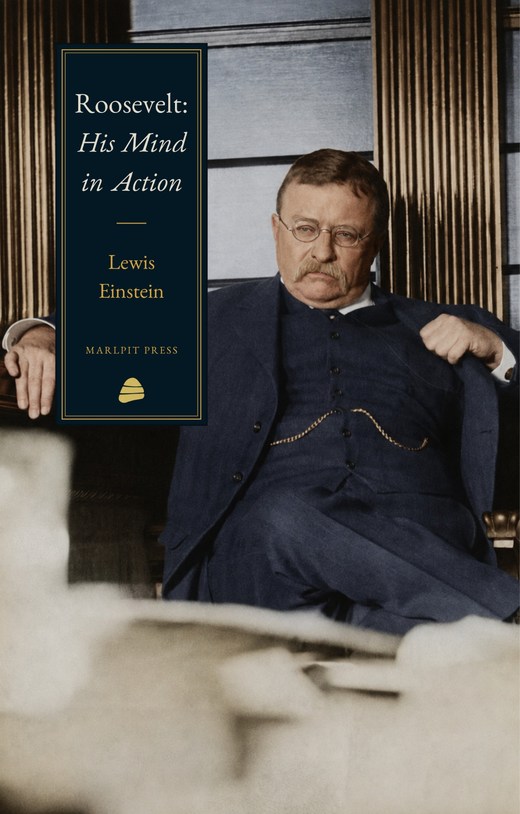
Research notes
All notesRoosevelt: His Mind in Action — Review & Historical Value
Why Lewis Einstein’s 1930 psychological portrait of Theodore Roosevelt still matters, where it remains sharp, and where its interwar assumptions show.
Read research noteLewis Einstein, Theodore Roosevelt, and Algeciras
How Einstein’s first-hand role at the 1906 Algeciras Conference shaped his understanding of Roosevelt’s secrecy, restraint, and diplomatic power.
Read research noteTheodore Roosevelt as Author of His Own Legend
Einstein’s strikingly modern argument that Roosevelt did not merely make history; he also worked consciously to shape how posterity would remember it.
Read research noteHow Reviewers Received Roosevelt: His Mind in Action
From Foster Rhea Dulles and the TLS to Oliver Wendell Holmes Jr., the 1930–31 reception reveals what readers found powerful and questionable in Einstein’s method.
Read research note