A Theodore Roosevelt biography about the mind behind the legend
Roosevelt: His Mind in Action is not a conventional cradle-to-grave life. Lewis Einstein says plainly that he wants to penetrate Roosevelt’s mind, identify the springs of action, and understand how ambition, patriotism, moral conviction, theatrical instinct, political calculation, and sheer appetite for experience could coexist in one personality.
That makes the book unusually modern for 1930. Einstein studies Roosevelt as both a political actor and a creator of the Roosevelt legend. He reads the Autobiography, authorized biographies, private letters, public performances, friendships, quarrels, and preserved explanations as evidence of a man acutely conscious of posterity.
The result is neither debunking nor hero worship. Einstein admires Roosevelt’s greatness while insisting that sincerity and calculation, public purpose and private ambition, spontaneity and stagecraft can all be present in the same act.
The atypical man who became a “typical American”
Einstein begins from a paradox. Roosevelt became perhaps the most recognizable representative of American energy even though his background was far from ordinary: old New York wealth, private education, Harvard, European travel, books, art, natural history, and a life without the economic struggle central to many American political myths.
Einstein’s answer is that Roosevelt made his American identity deliberately and sincerely. Ranching, military service, reform politics, friendships across class lines, relentless travel, and a cultivated knowledge of ordinary political organization all widened the range of people with whom he could identify.
This is one of Einstein’s strongest ideas. Roosevelt’s public authenticity was partly an achievement. He worked at understanding Americans, and he also understood the political force of being seen to understand them.
Power, publicity, and presidential leadership
Einstein treats Roosevelt’s appetite for power seriously without reducing it to selfishness. Roosevelt believed vigorous executive power could serve public purposes, and the presidency gave his need for mastery an institution large enough to match it.
He also had an extraordinary instinct for publicity. Physical adventure, picturesque language, attacks on concentrated wealth, highly visible meetings, dramatic quarrels, and constant contact with journalists made personality itself an instrument of government.
Einstein’s vocabulary belongs to 1930, but the phenomenon he describes looks familiar today: a president using media attention, personal identification, and moral drama to make issues vivid to the public.
Foreign policy from a diplomat who saw Roosevelt at work
Einstein’s diplomatic chapters carry unusual authority because he had served inside Roosevelt-era diplomacy. In 1906 he was secretary of the American delegation to the Algeciras Conference, one of the major crises of Roosevelt’s foreign policy.
The experience taught him something important. Even as a well-placed official handling dispatches and cipher work, Einstein did not realize at the time how much Roosevelt was conducting privately through trusted ambassadors and carefully judged communications. He later discovered a president far more patient and secretive than the public image of the impulsive cowboy suggested.
Einstein therefore reads “speak softly and carry a big stick” as a practical theory of deterrence. Credible power could make restraint possible. His chapters on Morocco, Portsmouth, Venezuela, Japan, Santo Domingo, Cuba, Panama, and the fleet repeatedly ask how threats, secrecy, reputation, and audience interacted.
1912, adversity, and what happens after power
Einstein is especially penetrating on the Progressive revolt of 1912. He accepts Roosevelt’s reform convictions as real while refusing to make doctrine the whole explanation. The revolt also offered personal vindication, leadership, movement, spectacle, and a new arena for a man who found political inactivity almost unbearable.
The later chapters then turn the method against heroic simplification. After the presidency, and especially after the defeat of 1912, Roosevelt still possessed the same energy but no longer controlled the institution that had perfectly fitted his personality.
Einstein’s analysis of the African tour, the Brazilian expedition, preparedness, hostility to Woodrow Wilson, and Roosevelt’s struggle for continued relevance gives the final third of the book much of its psychological force.
Lewis Einstein knew Roosevelt, but was not an intimate
Einstein’s relationship to Roosevelt is unusually useful for a biographer. He was close enough to know the diplomatic world, correspond with Roosevelt during the presidency, serve at Algeciras, meet him afterward, and argue with him about war and peace. He was not so intimate that friendship required reverence.
Roosevelt took Einstein seriously as a historian and diplomat. Their surviving correspondence includes praise for Einstein’s historical writing and a long 1915 disagreement over peace, preparedness, and international enforcement.
That position, informed associate rather than sacred confidant, helps explain the tone of the book. Einstein can admire Roosevelt’s scale while questioning the stories Roosevelt told about himself.
How reliable is Roosevelt: His Mind in Action?
Einstein worked from Roosevelt’s Autobiography, Joseph Bucklin Bishop’s documentary biography, Henry Cabot Lodge correspondence, Cecil Spring Rice, Oscar King Davis, speeches, memoirs, political records, his own recollections, and Roosevelt correspondence in his possession. The book also includes notes, an appendix, and an index.
Its greatest methodological strength is source criticism aimed at self-presentation. Einstein keeps asking why Roosevelt told a story in a particular way, what he omitted, why explanatory letters were copied, and how he tried to shape what posterity would remember.
Its chief weakness is psychological overreach. Einstein sometimes moves from evidence to statements about what Roosevelt felt “deep down” with more confidence than a modern historian would allow. The book is therefore strongest as a sharply argued interpretation, not as a substitute for a full modern scholarly biography.
The limits of a 1930 interpretation
Einstein’s own assumptions are part of the historical value of the book. He belonged to an interwar diplomatic elite that was comfortable with imperial hierarchy, vigorous executive action, and paternalistic language about weaker states. His treatment of Panama, Latin America, colonial rule, race, and the “white man’s burden” requires historical context.
The book is also selective. Social policy, labor, conservation administration, race relations, Native policy, the Philippines, and the institutional machinery of Progressivism receive uneven attention because Einstein chooses episodes that illuminate character.
Read with those limits in view, the book becomes doubly useful: as an early interpretation of Theodore Roosevelt and as a document of the generation of diplomats and intellectuals trying to decide what kind of leadership Roosevelt represented.
Contemporary reception and later reputation
The book received serious but mixed attention. Foster Rhea Dulles in The Bookman found Einstein’s psychological portrait “stimulating and highly readable.” An unsigned Times Literary Supplement reviewer accepted parts of the argument but questioned whether the book as a whole was justified.
Oliver Wendell Holmes Jr., who knew both Roosevelt and Einstein, privately told Einstein that his estimate seemed “wisely and delicately formed,” while suspecting that Einstein had made Roosevelt somewhat larger than Holmes himself remembered him.
Its later survival is more striking than its initial sales record. The Theodore Roosevelt Association’s annotated bibliography has continued to single Einstein out as one of the relatively few early Roosevelt interpretations still worth consulting.
About Lewis Einstein
Lewis David Einstein (1877–1967) was an American diplomat, historian, essayist, and scholar. Educated at Columbia, he began as a student of Renaissance literature and history before entering the diplomatic service in 1903.
His posts and assignments included Paris, London, Constantinople, Peking, Costa Rica, wartime Bulgaria, and Prague. He served as United States minister to Czechoslovakia from December 1921 to February 1930. Richard Crane preceded him, so the often-repeated claim that Einstein was the first U.S. minister there is incorrect.
Einstein’s books ranged from The Italian Renaissance in England and Napoleon III and American Diplomacy to Inside Constantinople, Tudor Ideals, Divided Loyalties, and the posthumous memoir A Diplomat Looks Back. His career repeatedly joined scholarship to practical diplomacy.
About this Marlpit Press edition
This Marlpit Press edition restores Einstein’s 1930 interpretive biography for readers interested in Theodore Roosevelt, presidential leadership, the Progressive Era, political psychology, and American foreign policy.
The edition is presented as what the book actually is: a compact, argument-driven study by a Roosevelt-era diplomat with personal access and first-hand experience of the diplomatic world he describes.
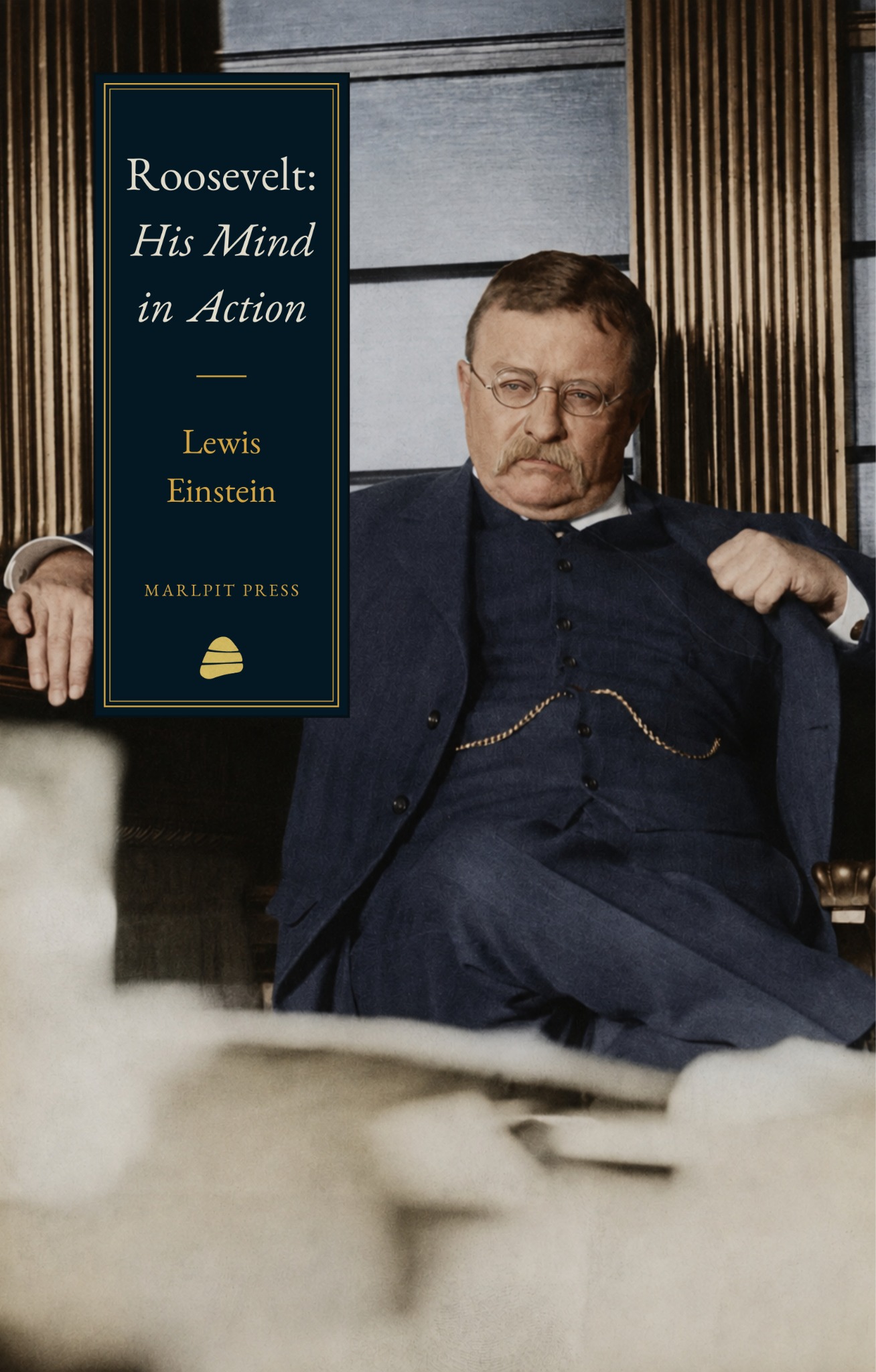
The cover places Roosevelt in the White House setting that best matches Einstein’s subject: the politician as public personality, executive, strategist, and deliberate maker of his own historical image.
 MARLPIT PRESSIndependent Publisher