A vivid life of Elizabeth I
Queen Elizabeth was published in 1929, when biography was becoming shorter, more psychological, and more literary. Katharine Anthony took one of the most famous reigns in English history and deliberately narrowed the frame. Her central subject is Elizabeth herself: how childhood danger, admiration, fear, courtship, rivalry, and the pressure of sovereignty formed the woman who became the Virgin Queen.
The result is unusually intimate for a biography of a monarch. Henry VIII and Anne Boleyn matter because they shape Elizabeth’s childhood. Thomas Seymour matters because Anthony sees the adolescent crisis around him as formative. Leicester and Alençon are treated as both personal attachments and political problems. Mary Stuart, Philip II, the Armada, and Essex enter the story where public history presses most directly upon Elizabeth’s character.
Anthony admires Elizabeth’s intelligence, endurance, and political instinct without turning her into a saint. Her queen can be vain, bullying, flirtatious, miserly, evasive, ruthless, and astonishingly self-controlled. That refusal of reverential biography was exactly what some contemporary readers found refreshing.
The woman behind the Virgin Queen
Anthony organizes the reign around the problem that fascinated her most: how a woman exercised sovereignty in a political culture built around male kingship. Marriage could never be merely romantic. A husband would affect succession, religion, foreign alliances, household power, and Elizabeth’s own control of the crown.
That is why the long relationships with Robert Dudley, Earl of Leicester, and François, Duke of Alençon, receive so much attention. Anthony treats courtship as a place where private desire and public strategy become almost impossible to separate.
Her final interpretation gathers the book together symbolically. Elizabeth refuses a literal husband and leaves no child, but Anthony argues that the energies conventionally assigned to marriage and maternity are redirected into kingship. It is a distinctly twentieth-century psychological reading of a sixteenth-century queen, and it gives the biography its strongest unifying idea.
From Thomas Seymour to Mary Stuart and the Armada
Anthony gives exceptional weight to Elizabeth’s dangerous adolescence in the household of Katherine Parr and Thomas Seymour. She treats that episode as an early lesson in the risks of intimacy, sexual scandal, and political vulnerability. Later chapters repeatedly return to the guardedness and appetite for admiration that Anthony believes grew from those years.
Mary, Queen of Scots provides a different kind of mirror. Anthony’s Elizabeth faces a rival queen whose claim to the English throne, Catholic identity, imprisonment, and eventual execution turn personality into a dynastic and international crisis.
The Armada chapter is where Anthony’s personal method expands most successfully into national history. Elizabeth at Tilbury becomes ruler, performer, military symbol, and focus of English identity at once. The aging queen’s relationship with the Earl of Essex then provides the final intimate drama before the last Tudor’s decline and death.
A Literary Guild selection in the age of the New Biography
Alfred A. Knopf published Queen Elizabeth in New York in 1929. The U.S. Copyright Office record gives October 4 as the copyright date, and the Literary Guild selected the book for October, giving Anthony immediate national book-club exposure.
The timing matters. Lytton Strachey’s Elizabeth and Essex had appeared the year before, and biography was in the middle of an interwar transformation. Writers were replacing enormous Victorian lives with compression, psychological interpretation, intimate anecdote, irony, and novel-like pacing.
Anthony belonged to that movement but brought a background of her own. Before becoming a biographer she had worked in social research on working women and had written on feminism. Her interest in female agency, family structure, economic dependence, sexuality, and social constraint therefore predated the fashion for literary biography.
What contemporary reviewers saw
General literary reviewers often liked the qualities that professional historians distrusted. Agnes W. Smith in The New Yorker praised Anthony’s compact, unsentimental personal portrait and described its attitude as “justice without gallantry, admiration without illusion.” The magazine continued recommending the book through the 1929 holiday season and into January 1930.
The Spectator was more divided. Its reviewer disliked Anthony’s tendency to compress a complicated historical problem into a brilliant psychological formula, but still praised particular interpretations, including the Seymour episode, the Alençon courtship, and Elizabeth’s identification with England.
Historian Harold Hulme, writing in the Journal of Modern History, attacked the lack of footnotes, historical omissions, and Anthony’s religious history. A student reviewer in Indiana University’s Vagabond, meanwhile, praised the same book as concise, witty, readable, and novel-like. The split is a useful guide to the book: Anthony wrote serious biography for general readers, with the virtues and risks that choice entails.
How the biography holds up now
Anthony remains very good at making a complicated life move. She has a sharp eye for the ways childhood, humiliation, admiration, danger, and private relationships can form a public personality. She is also unusually attentive, for a popular biographer of 1929, to the historical problem of female power.
Modern readers should be more cautious when Anthony moves from evidence to psychological certainty. Her language about masculine and feminine character belongs to early twentieth-century psychology, and her treatment of Protestantism, Puritanism, and Catholicism is often too schematic. Parliament, finance, Ireland, diplomacy, and confessional networks receive much less space than they would in a modern political biography.
The best way to read Queen Elizabeth today is as a highly readable historical portrait with a strong interpretive point of view. It is valuable both for the Elizabeth it depicts and for the moment in the history of biography that it represents.
About Katharine Anthony
Katharine Susan Anthony (1877–1965) was an American social researcher, feminist writer, suffrage supporter, and biographer. Born in Roseville, Arkansas, she studied at Heidelberg and Freiburg and received a Ph.B. from the University of Chicago. She later taught English at Wellesley College before entering social research in New York.
Her early books included Mothers Who Must Earn and Feminism in Germany and Scandinavia. With Margaret Fuller: A Psychological Biography she moved decisively toward biography, followed by Catherine the Great, Queen Elizabeth, Marie Antoinette, Louisa May Alcott, Dolly Madison, Susan B. Anthony, and other lives of notable women.
Anthony’s importance lies partly in the continuity between those careers. She brought questions first encountered in social research and feminism into the literary biography of historical women, making personality, intimate life, gender expectations, and the exercise of agency central to her narratives.
About this Marlpit Press edition
This Marlpit Press edition returns Anthony’s 1929 portrait of Elizabeth I to print for readers of Tudor history, historical biography, and the literature of the interwar New Biography.
The original book was compact by design: twelve chapters followed by a bibliography and index. Its power comes from selection rather than encyclopedic coverage, and the Marlpit presentation preserves that fast-moving biographical argument rather than disguising the book as a modern scholarly history.
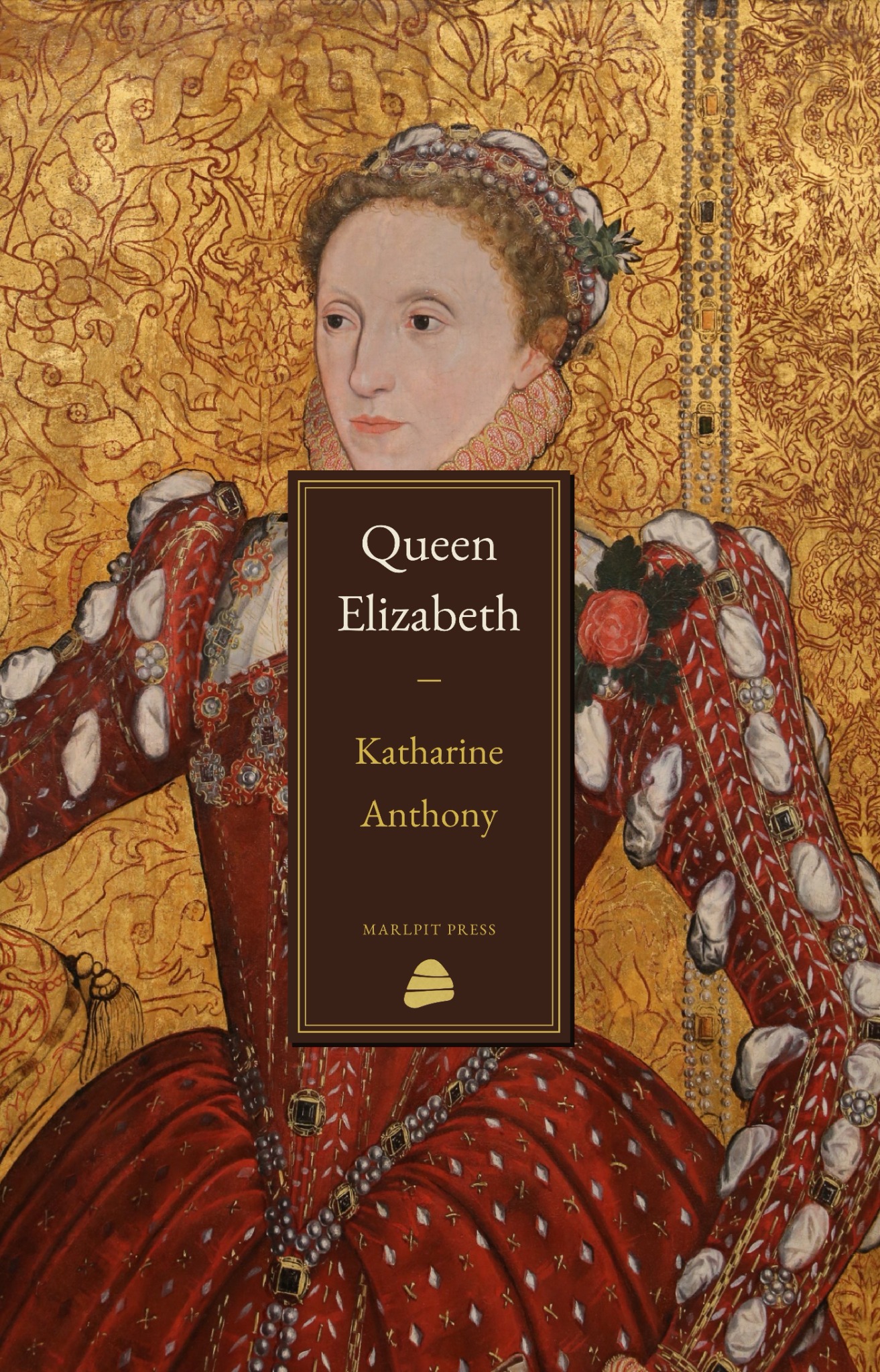
The cover uses the Hampden Portrait of Elizabeth, traditionally associated with the young queen early in her reign, pairing Anthony’s intimate psychological portrait with one of the most recognizable visual traditions of Tudor monarchy.
 MARLPIT PRESSIndependent Publisher