 MARLPIT PRESSIndependent Publisher
From agnosticism to Anglo-Catholicism
Alfred Edward John Rawlinson was born on 17 July 1884 at Newton-le-Willows in Lancashire and was raised in a Congregationalist family. He entered Corpus Christi College, Oxford, in 1904 as an agnostic.
During his undergraduate years he moved toward Anglican Christianity and became particularly attracted to the Anglo-Catholic tradition. That personal trajectory helps explain his lifelong refusal to choose between Catholic doctrine and intellectual freedom.
Oxford theologian
Rawlinson was ordained deacon in 1909 and priest in 1910. He taught at Keble College from 1909 to 1913 and became a Student and tutor of Christ Church in 1914.
Before the First World War he had already established the central concerns of his theology. His 1912 essay “The Principle of Authority” and his 1915 book Dogma, Fact and Experience asked how Christian authority could remain real while historical inquiry, reason, experience, and conscience remained free.
First World War chaplain
From 1915 to 1917 Rawlinson served as a temporary chaplain to the Forces. His work included preparing officers and enlisted men in military hospitals for Confirmation.
Those conversations directly produced Religious Reality: A Book for Men. In his own preface he explained that he needed a concise book covering both Christian belief and Christian practice as a whole.
Liberal Catholic Anglicanism
Rawlinson’s mature position joined Catholic sacramental and corporate religion to freedom of inquiry and historical criticism. Later scholarship identifies him as a significant representative of Anglican Liberal Catholicism.
He defended creed, sacrament, the visible Church, corporate worship, and inherited devotional practice while rejecting the idea that Christian faith required biblical inerrancy or the suppression of serious questions.
Durham and Derby
Rawlinson left Oxford in 1929 to become Canon of Durham and Archdeacon of Auckland. He continued writing on authority, Anglican identity, and Church unity.
In 1936 he became Bishop of Derby, a position he held until 1959. His episcopate spanned the Second World War and the rapid growth of modern Anglican ecumenical activity.
Major works
Rawlinson’s later books included Catholicism with Freedom (1922), Authority and Freedom (1924), The New Testament Doctrine of the Christ (1926), The Church of England and the Church of Christ (1930), and The Anglican Communion in Christendom (1960).
Many of the themes developed in those works are already compressed into Religious Reality: authority, freedom, Catholicity, historical criticism, Christology, social ethics, sacramental life, and the relation between doctrine and experience.
Death and legacy
Rawlinson resigned the see of Derby in 1959 and died in London on 17 July 1960, his seventy-sixth birthday.
His enduring interest lies in a theological synthesis that remains recognizable today: intellectually open Christianity with strong supernatural, sacramental, ecclesial, and ethical commitments.
Marlpit Press edition
All books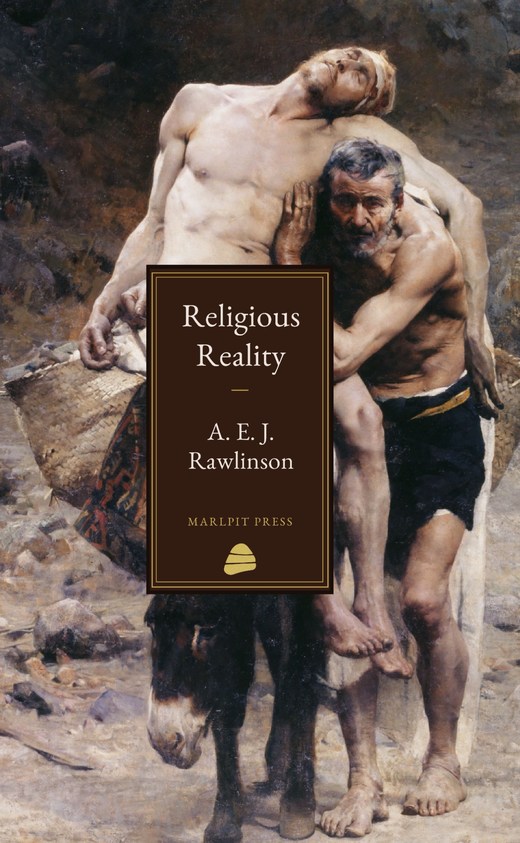
Research notes
All notesWhy A. E. J. Rawlinson Wrote Religious Reality
How military-hospital Confirmation work during the First World War produced a compact Christian book for adult men.
Read research noteHow Reviewers Received Religious Reality in 1918–1919
What The Expository Times and International Journal of Ethics actually praised, questioned, and found unusual.
Read research noteA. E. J. Rawlinson and Liberal Catholic Anglicanism
How Rawlinson combined sacramental Catholic Christianity, historical criticism, intellectual freedom, and a strong doctrine of the Church.
Read research noteReligious Reality on War, Labour, Politics, and Work
Why Rawlinson thought Christianity had to judge economic life, nationalism, labour relations, citizenship, and war.
Read research noteWhat Does “A Book for Men” Mean in Religious Reality?
Why Rawlinson addressed male readers directly about work, politics, military service, sex, marriage, discipline, worship, and responsibility.
Read research note