The travel book that invented Richard Halliburton
The Royal Road to Romance is best understood as the book in which Richard Halliburton invented Richard Halliburton. The journeys were real, but the lasting creation was the persona: young, funny, reckless, romantic, theatrical, and absolutely unwilling to let respectable adulthood arrive on schedule.
Halliburton graduated from Princeton in 1921 and set out to see the world on his own terms. The resulting journey lasted roughly eighteen months and carried him through Europe, North Africa, India, the Himalayas, Southeast Asia, China, and Japan.
What made the book extraordinary was not simply distance traveled. Halliburton wanted to turn famous places into personal adventures. Mountains became opponents, ruins became stages, and history became something to climb, swim through, sleep on, reenact, or otherwise physically enter.
Matterhorn, Great Pyramid, Taj Mahal, Khyber Pass, Angkor, Mount Fuji
The thirty-seven chapters move with the rhythm of short performances. Halliburton climbs the Matterhorn with little previous mountaineering experience, is arrested at Gibraltar after photographing prohibited military installations, spends a night on the Great Pyramid after the tourists leave, and swims in the Nile.
In India he swims in the Taj Mahal reflecting pool by moonlight, then pushes north through Punjab, Kashmir, Ladakh and Leh before crossing the Khyber Pass. Farther east come Bangkok, the ruins of Angkor, China, an encounter with pirates near Macau, and Japan.
The climax is a solitary winter ascent of Mount Fuji. Halliburton reached the summit around his twenty-third birthday in January 1923, then returned to the United States as a working seaman aboard the President Madison.
A revolt against respectability
Travel is only half the subject. The other half is Halliburton’s refusal of the ordinary adult life he saw waiting for his Princeton classmates: business, routine, money-making, domesticity, safety, and what he repeatedly calls “respectability.”
The opening chapter draws explicitly on Oscar Wilde’s The Picture of Dorian Gray and turns youth into a philosophy. Halliburton wants experience itself to become the measure of a successful life.
That is also the meaning of “romance” in the title. The word points less toward romantic love than toward adventure, wonder, enchantment, beauty, the picturesque, and the possibility that ordinary life might be escaped.
Why the prose moves so fast
Halliburton had learned to tell these stories before he learned to sell the book. After returning from his travels in 1923, he struggled to sell his articles in New York. The breakthrough came on the lecture circuit.
Speaking before live audiences taught him which stories made people laugh, gasp, and lean forward. The book emerged after that apprenticeship. Its chapters tend to establish a place, create a difficulty, throw Halliburton into it, and end with a comic, romantic, or dramatic payoff.
That oral quality explains much of the book’s enduring speed. It also explains why readers often loved Halliburton more than literary critics did.
From rejected manuscript to three-year bestseller
The finished book was anything but effortless. Halliburton withdrew to Nantucket to write while maintaining a punishing lecture schedule and reportedly suffered a breakdown of sorts during composition.
Publishers initially rejected the manuscript as sophomoric. Bobbs-Merrill finally accepted it in April 1924, but required substantial cuts. Halliburton accepted the editing and refused to surrender the title The Royal Road to Romance, even though the publisher disliked it.
The book appeared in 1925, entered bestseller lists within months, remained a bestseller for three years, and was eventually published in fifteen languages. It transformed a successful lecturer into one of the most famous American adventurers of his generation.
What contemporary reviewers actually saw
The early reviews were more complicated than the famous jacket blurbs suggest. Nearly everyone noticed youth, speed, exuberance, and Halliburton’s infectious appetite for escape.
A November 1925 newspaper notice effectively warned parents that the book might cause their sons to disappear at dawn. Commonweal admired the authenticity and charm of Halliburton’s personal approach while also calling the achievement somewhat facile. The Saturday Review of Literature memorably described the journey as a period of “emotional inebriation.”
The famous Boston Transcript blurb called Halliburton’s spirit mad, exhilarating, joyous, and an incarnation of youth. Those promotional quotations are valuable, but they are excerpts rather than necessarily complete critical judgments.
What not to confuse with this book
Several of Halliburton’s most famous exploits happened later and are frequently imported into descriptions of The Royal Road to Romance by mistake.
His Hellespont swim belongs to the later journey behind The Glorious Adventure. The Panama Canal swim belongs to New Worlds to Conquer. The open-cockpit airplane journey belongs to The Flying Carpet. The elephant crossing of the Alps belongs to the later period associated with Seven League Boots.
Keeping the chronology straight matters because the journey in Royal Road is already extraordinary enough: Matterhorn, Gibraltar, Egypt, India, the Himalayas, Angkor, China, and Fuji.
Truth, performance, and the Halliburton myth
Halliburton really did undertake dangerous journeys, difficult climbs, long crossings, arrests, swims, and improvised travel. He also understood publicity exceptionally well.
That combination made him an early master of celebrity travel writing. The lived feat and the narrated feat were related, but they were not identical products. Halliburton selected, arranged, heightened, and performed experience for an audience.
This is part of the book’s historical fascination. Long before modern influencer culture, Halliburton had discovered a recognizable formula: go somewhere spectacular, perform something unusual there, photograph it, tell the story vividly, and make the traveler’s personality inseparable from the destination.
A century later
The book is now historical in two ways. It records a journey through the early 1920s, and it records how an affluent, educated young American of that era imagined the wider world.
Modern readers should expect the exoticizing assumptions common to early twentieth-century American travel literature. Local people can become scenery or types, colonial structures receive little analysis, and Halliburton’s own freedom is made possible by privileges he rarely examines.
Those limitations are worth seeing clearly. They coexist with the book’s real gifts: velocity, comic timing, visual imagination, scene-making, and the ability to communicate enthusiasm without embarrassment.
About Richard Halliburton
Richard Halliburton (1900–1939) was an American travel writer, lecturer, adventurer, and one of the earliest modern celebrity travelers. A Princeton graduate, he turned the journey behind The Royal Road to Romance into a career that combined books, newspaper publicity, live lectures, photography, radio, and increasingly elaborate adventures.
His later books included The Glorious Adventure, New Worlds to Conquer, The Flying Carpet, Seven League Boots, and the immensely popular Book of Marvels volumes.
Halliburton disappeared in the Pacific in 1939 aboard the Chinese junk Sea Dragon, which he had planned to sail from Hong Kong to San Francisco for the Golden Gate International Exposition. He was thirty-nine.
About this Marlpit Press edition
This Marlpit Press edition returns Halliburton’s 1925 travel classic to readers interested in adventure literature, classic travel writing, the 1920s, and the history of modern travel celebrity.
The edition preserves the book’s identity as a fast, personal, performance-driven narrative rather than treating it as a modern guidebook or sober work of geography.
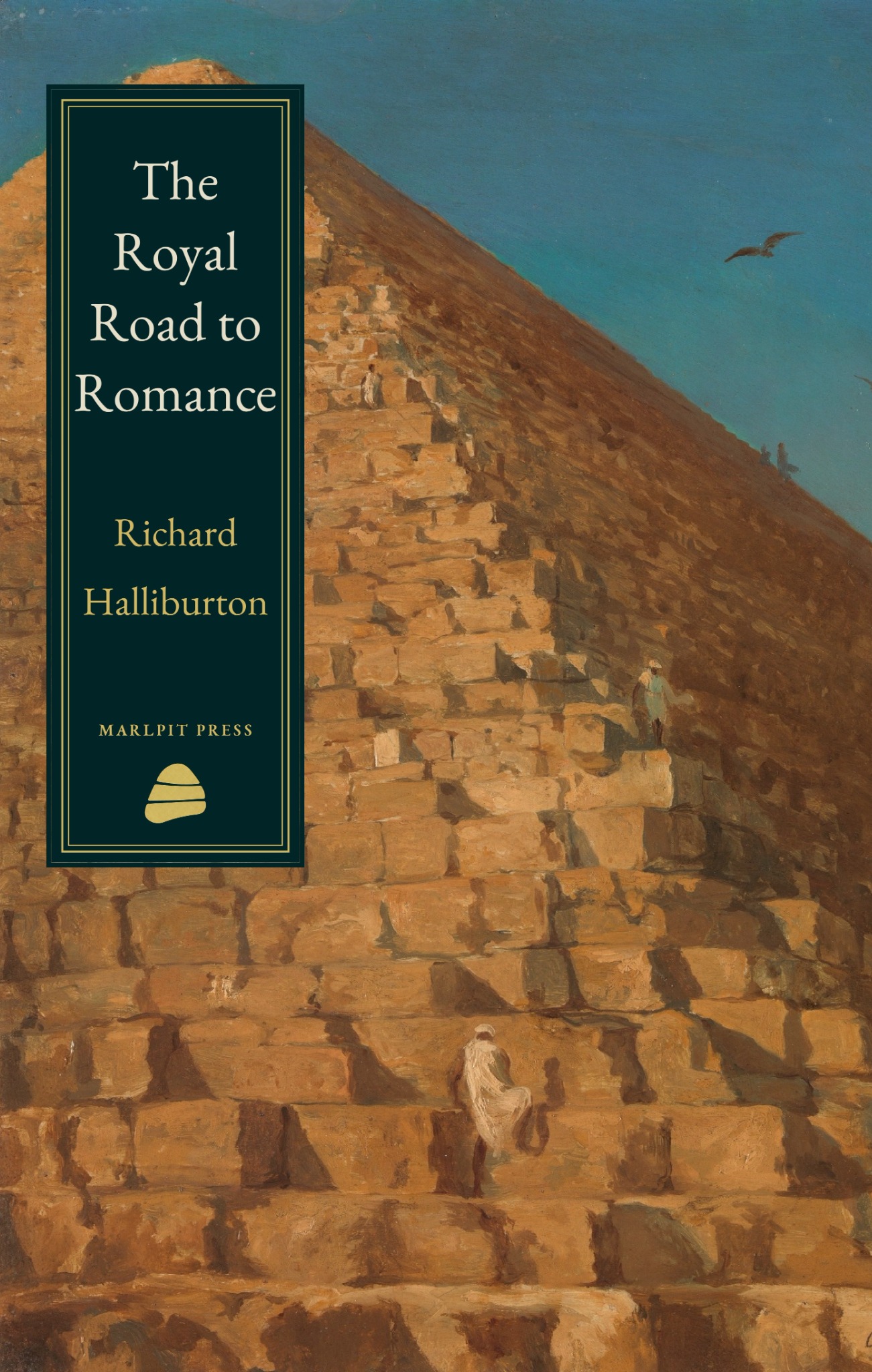
The cover’s pyramid imagery reflects one of Halliburton’s defining habits: famous places were never merely destinations. They were invitations to turn history and landscape into an experience unmistakably his own.
Classic travel writing
The Royal Road to Romance — Review & Historical Value
Why Halliburton’s 1925 bestseller still works, where its early-twentieth-century assumptions show, and how to read it a century later.
Read research noteTravel itinerary
Where Richard Halliburton Goes in The Royal Road to Romance
A precise guide to the 1921–23 journey: Matterhorn, Gibraltar, Egypt, India, the Himalayas, Angkor, China, and Mount Fuji.
Read research noteContemporary reception
How Reviewers Received The Royal Road to Romance in 1925
The book’s earliest critics saw exactly what readers loved: youth, speed, danger, emotional intoxication, charm, and the infectious fantasy of escape.
Read research noteTravel celebrity
How Richard Halliburton Invented the Celebrity Travel Writer
Books, lectures, photographs, newspaper stunts, and personality-driven adventure made Halliburton feel surprisingly modern.
Read research note MARLPIT PRESSIndependent Publisher