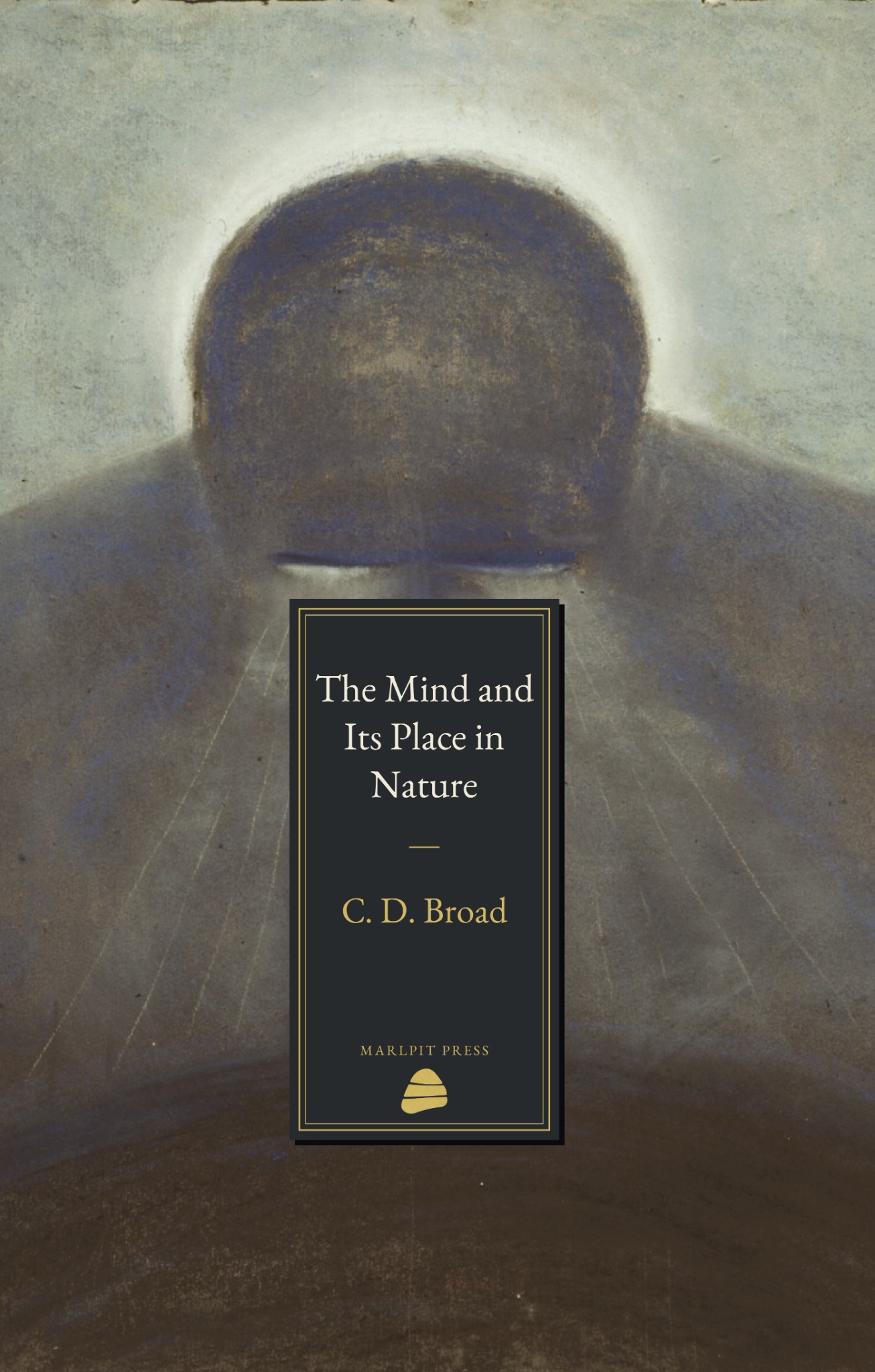
A classic of philosophy of mind
The Mind and Its Place in Nature is at once a philosophy-of-mind treatise, a work of scientific metaphysics, an epistemology of perception and memory, a study of the unconscious, an examination of arguments for survival after death, and a systematic map of the possible relations between mind and matter.
Broad’s governing question is larger than whether mind is material or immaterial. He asks what kinds of fact a complete description of nature must contain, how the sciences relate to one another, and whether mentality can be derived from lower-level physical and biological facts.
The culminating classic of British emergentism
Broad’s most influential contribution is his rigorous account of emergence. A complex whole is not genuinely emergent merely because it has properties its individual parts lack. The stronger claim is that the characteristic behavior or qualities of the whole cannot be deduced, even in principle, from complete knowledge of the lower-level constituents, their arrangement, and the laws governing them.
This made the 1925 book the culminating classic of British emergentism and a continuing reference point in debates about reduction, explanatory autonomy, higher-level laws, and the relation between consciousness and the physical world.
The mathematical archangel and consciousness
Broad’s famous “mathematical archangel” thought experiment anticipates a central modern problem about consciousness. Imagine an intellect possessing complete microscopic knowledge of a physical system. Would that knowledge alone reveal what a previously unexperienced qualitative sensation is like?
Broad’s answer is that complete structural and physical knowledge may still fail to yield the qualitative character of experience. He develops the point through emergence rather than the later language of complete physical information, but the argument has become part of the prehistory of the modern knowledge argument and explanatory gap.
From Broad to David Chalmers
The influence is not merely retrospective. David Chalmers explicitly treated Broad’s “mathematical archangel” as an early epistemic argument against reductive materialism and used Broad’s classificatory method as a model for his own work on consciousness.
Broad’s final chapter enumerates seventeen possible types of mind-matter theory before eliminating or ranking them. Chalmers later revived that divide-and-conquer strategy in Consciousness and Its Place in Nature, a title that deliberately echoes Broad.
Beyond materialism versus dualism
Broad believed the familiar opposition between materialism, dualism, and idealism concealed too many logically distinct possibilities. Mentality might be fundamental, emergent, reducible, or merely apparent; materiality could be treated in parallel ways; and mental and material characteristics might arise from or combine with a neutral basis.
The result is a seventeen-way taxonomy of mind and matter. Its lasting importance lies less in the labels than in the method: enumerate the genuine logical options before deciding which one the evidence favors.
Broad’s actual position on mind and matter
Broad’s conclusion is often shortened to “emergent materialism,” but the book is more careful. Restricting attention to ordinary psychological and physical evidence, he regarded Emergent Materialism as the most reasonable general picture.
On that view, mentality is real, irreducible, and dependent on organized material systems without requiring a separately existing Cartesian soul. Yet Broad thought some psychical-research evidence strong enough to prevent him from stopping there.
Taking that wider evidence into account, he gave the highest probability to a modified Compound Theory compatible with emergent materialism, allowing that persistent psychic factors might have to be added to the familiar nervous system. His metaphysics is therefore explicitly conditional on the evidence admitted.
Perception, memory, other minds, and the unconscious
The middle of the book ranges far beyond the abstract mind-body problem. Broad analyzes sense-perception, the status of physical objects, memory, introspection, knowledge of other minds, the meanings of “unconscious,” evidence for unconscious mental events, and the nature of traces and dispositions.
This breadth is part of the argument. A theory of mind must survive contact with the ordinary ways minds know the world and one another as well as with dreams, hypnosis, dissociation, abnormal psychology, and cases that stress the unity of the self.
Psychical research and survival after death
Modern readers sometimes treat Broad’s chapters on psychical research and survival as detachable period curiosities. Broad himself did not. If the subject is the place of mind in nature, then evidence that information, agency, or personal characteristics can occur outside familiar sensory and neural channels would bear directly on the ontology of mind.
His procedure is cautious rather than credulous. Survival is one hypothesis among competitors including fraud, normal information channels, chance, telepathy, clairvoyance, cryptomnesia, suggestion, and mistaken reporting. The task is to compare explanatory alternatives rather than to treat the unexplained as automatically paranormal.
How the book was made
The book originated in the second course of Tarner Lectures at Trinity College, Cambridge. Broad was invited in 1922 and delivered the lectures in Michaelmas 1923 while beginning new teaching duties at Trinity.
He later judged the lectures seriously inadequate. During the Long Vacation of 1924 and the following Michaelmas term he rewrote and greatly enlarged them, producing the 674-page text published in 1925. The finished book is therefore a post-lecture reconstruction rather than a transcript.
Contemporary reception
The book attracted immediate attention across philosophical and intellectual journals. Bertrand Russell reviewed it twice, first in The Nation and the Athenaeum in November 1925 and then in an eight-page review in Mind in January 1926.
Contemporary publisher advertising preserved Russell’s praise for Broad’s “accurate thought and useful distinctions,” while a Times Literary Supplement excerpt called the volume one of the most important recent contributions to philosophy. Reviews also appeared in Philosophy, Science Progress, the Journal of Philosophy, Social Forces, and other venues.
About C. D. Broad
Charlie Dunbar Broad (1887–1971) was one of the major British philosophers of the twentieth century. Trained first in mathematics and natural science at Trinity College, Cambridge, he moved into Moral Sciences and built a career spanning metaphysics, epistemology, philosophy of science, ethics, philosophy of religion, and psychical research.
He taught at St Andrews, Dundee, Bristol, and Cambridge and became Knightbridge Professor of Moral Philosophy in 1933. His major books include Perception, Physics, and Reality, Scientific Thought, Five Types of Ethical Theory, and his two-volume Examination of McTaggart’s Philosophy.
Broad was famous for mapping a philosophical problem from every angle before judging among the alternatives. That method reaches its most ambitious form in The Mind and Its Place in Nature.
Why The Mind and Its Place in Nature still matters
The book remains historically central because several arguments now associated with contemporary philosophy of consciousness appear here in strikingly mature form: irreducible emergence, the limits of physical deduction, the qualitative character of experience, and systematic alternatives to reductive materialism.
Its deeper value is methodological. Broad refuses to let philosophical fashion decide what kinds of evidence count in advance. He clarifies the options, states the costs of each theory, and allows the ranking to change when the evidence changes.
 MARLPIT PRESSIndependent Publisher